Agentic commerce is a new way of online shopping where AI agents help people discover products, compare prices, and even make purchases automatically.
For decades, buying meant patience: see an ad, browse sites, compare prices, fill out forms, and pay.
Today, that multi-step funnel collapses into a single request: ask AI, let it scan the web, find the best deal, and execute the purchase. The traditional friction of online shopping simply disappears.
In simple terms:
- Old Funnel: Customer sees an ad > Browse sites > Compare prices > Fill out forms > Pay
- New Funnel: Customer asks AI > AI scans web > AI finds best deal > AI buys it
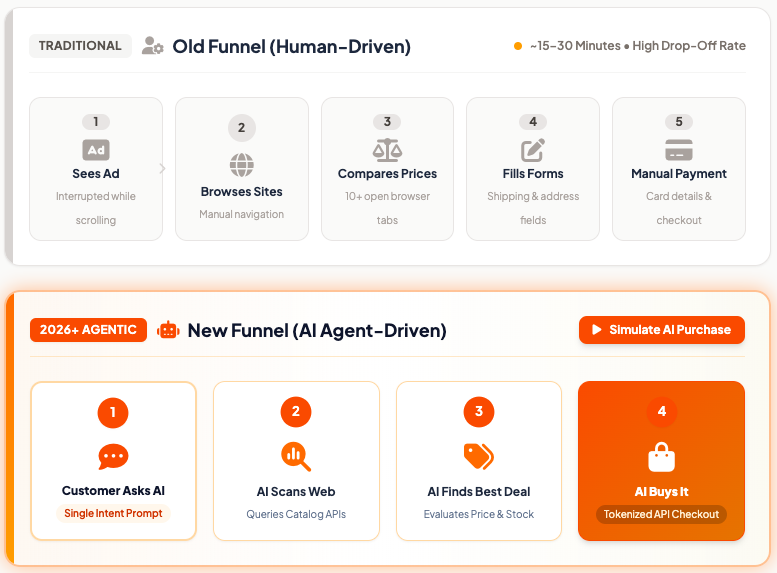
This guide explains how these AI assistants are eliminating shopping chores and completely changing how we buy products.
Why Businesses Must Adapt for Agentic Commerce
Agentic commerce is changing how businesses sell online by shifting the focus from traditional marketing to AI decision-making.
- Reach customers through AI shopping assistants, creating a new sales channel beyond search engines and marketplaces.
- Gain a competitive advantage by making your products easier for AI agents to discover, compare, and purchase.
- Improve conversion rates as AI agents recommend products that best match customer needs.
- Build long-term customer relationships through automated reorders and repeat purchases managed by AI.
- Reduce customer acquisition costs by earning recommendations from AI agents instead of relying solely on paid advertising.
- Future-proof your ecommerce business as AI-powered shopping becomes a mainstream buying behavior.
- Increase operational efficiency with real-time inventory, pricing, and product data that support automated purchasing.
- Stay competitive as more ecommerce platforms and marketplaces adopt agentic commerce standards.
How Does Agentic Commerce Work?
Agentic commerce strips away the visual clutter of the internet and turns shopping into a smooth background process. Here is how a typical transaction works:
Step 1: You Give Context
Instead of typing rigid keywords like “black running shoes size 10,” you talk to your AI: “Find me a pair of durable running shoes for wet weather under ₹7,000. They need to have great reviews and must arrive before my trip on Friday.”
Step 2: The AI Scans the Web
The AI agent does not browse websites the way you do. It ignores flashy ads and banners, moving directly into the backend product databases of hundreds of stores simultaneously to match your exact criteria.
Step 3: The Agent Builds the Cart
The agent filters out promotional noise, fake reviews, and overpriced options. It selects the absolute best match for your needs and constructs the digital cart.
Step 4: Secure Execution
The system uses secure digital tokens to finalize the payment. The AI completes the checkout securely within its own chat interface. You never have to manually enter your address or credit card digits.
Examples of Agentic Commerce
As AI shopping assistants become part of the buying journey, businesses are changing how they sell online. Instead of relying only on search rankings and paid ads, they are making their stores AI-ready so autonomous shopping agents can discover products, compare options, and complete purchases.
Here are some examples of how businesses can benefit from agentic commerce.
1. ChatGPT Shopping Finds and Recommends Products
A shopper asks ChatGPT: “Find me the best wireless earbuds under $150 with active noise cancellation.”
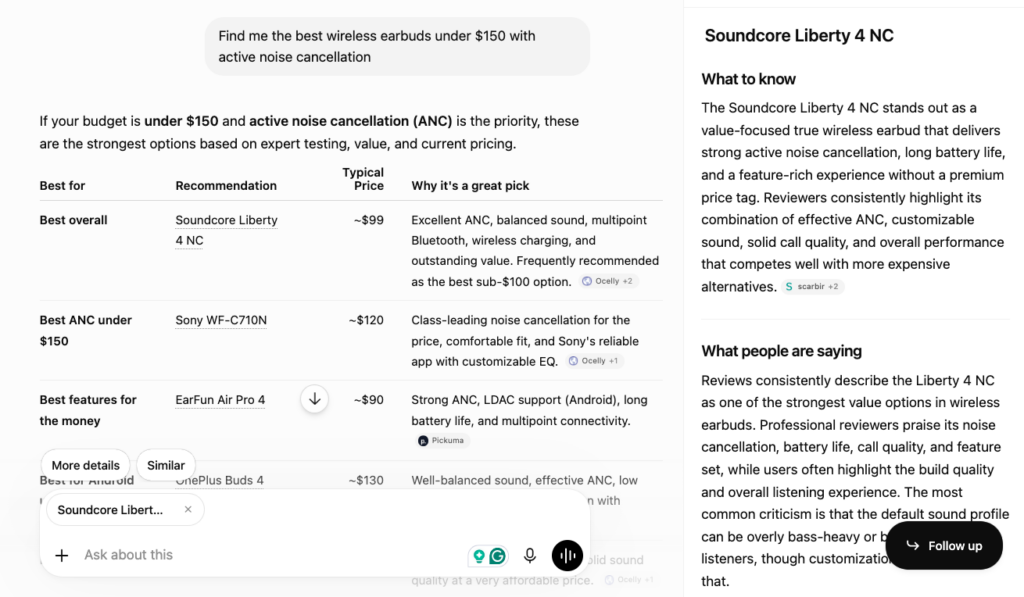
Instead of browsing dozens of websites, ChatGPT compares products across multiple retailers, evaluates reviews, pricing, and features, and recommends the best options. As agentic commerce evolves, AI assistants will increasingly complete purchases directly for users.
2. Amazon’s Buy for Me
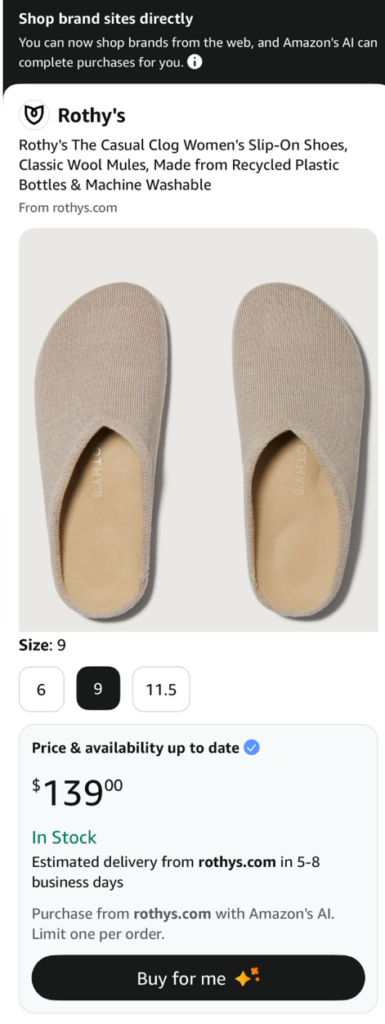
Amazon’s Buy for Me feature allows customers to purchase products from third-party brand websites without leaving the Amazon Shopping app. If an item isn’t sold directly on Amazon, the AI agent securely visits the brand’s website, fills in checkout details, completes the purchase, and keeps customers updated on their order all within Amazon’s interface.
3. Visa Intelligent Commerce
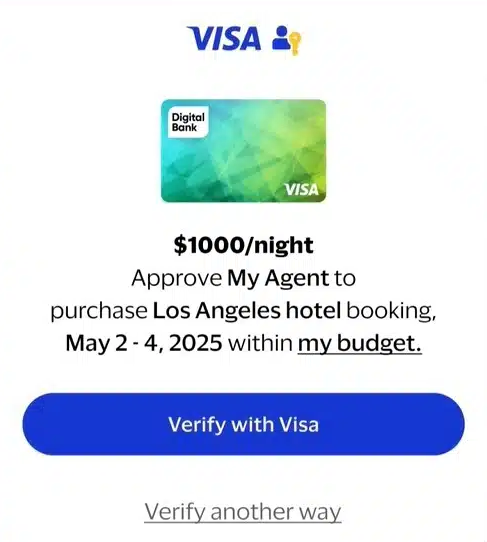
Visa is building infrastructure that lets trusted AI agents make purchases on behalf of users. Customers can set spending limits, preferred merchants, and approval rules. Once authorized, the AI can complete transactions securely without requiring the customer to manually enter payment details every time.
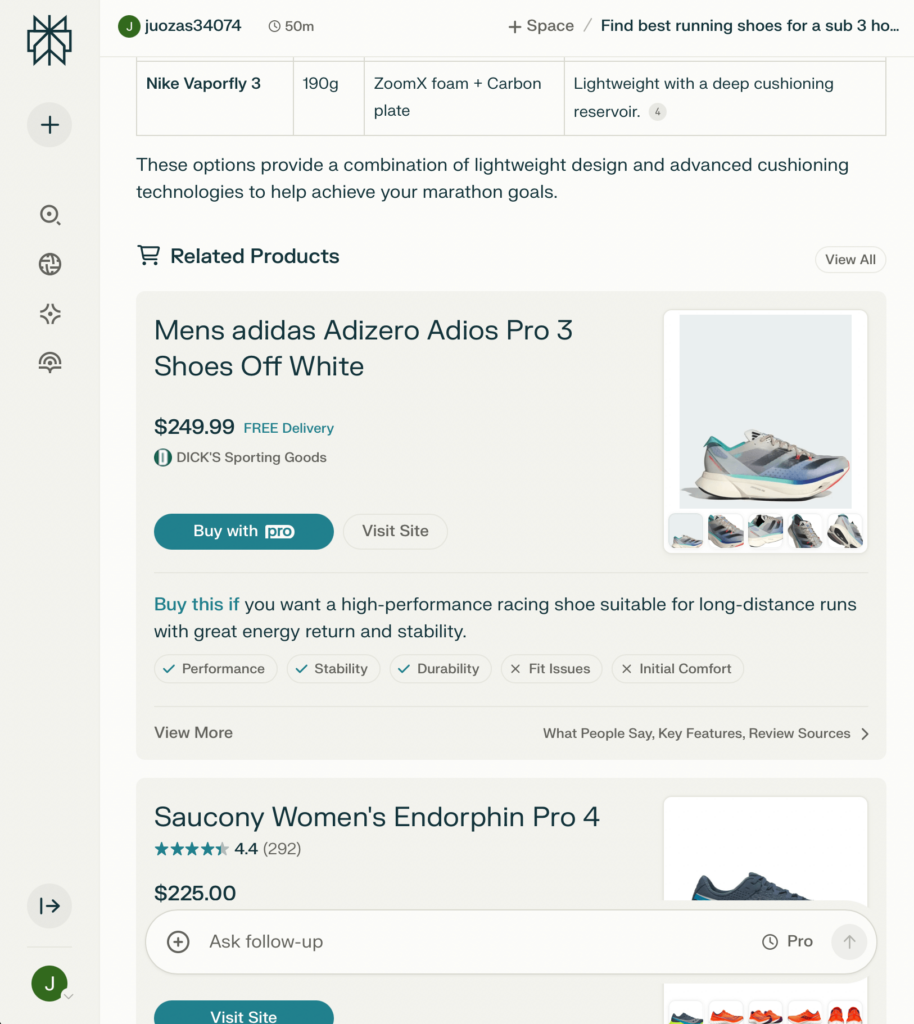
4. Perplexity Shopping Assistant
A user asks Perplexity: “I need a lightweight laptop for video editing under $1,200.”
The AI researches products across retailers, compares specifications, reviews, and pricing, then recommends the most suitable option. Instead of keyword searches, shoppers receive personalized recommendations based on their specific needs.
Final Thoughts – How Businesses Must Adapt to Survive
To stay competitive in agentic commerce, businesses must build AI-ready ecommerce stores with accurate product data, real-time inventory updates, and fast APIs that AI agents can easily understand and use.
If AI agents encounter incorrect pricing or stock issues, they may quickly move purchases to competitors. Meetanshi helps merchants build scalable, AI-ready Magento stores designed for the future of automated commerce.
Contact our expert team to get started with leveraging the performance of your online store.
Contact Us Now