Shoppers are no longer just searching for products. They are asking ChatGPT, Gemini, and Perplexity to find a product, compare options, and buy it for them.
It is no longer whether your store has AI features. It is whether an external AI agent, acting for a shopper, can complete a purchase on your store.
That capability is what makes a platform agentic commerce ready. Most platforms are not there yet, and the gap between marketing claims and working infrastructure is wide.
This guide explains what agentic commerce is, the capabilities a platform needs, the protocols involved, and where the major ecommerce platforms stand.
What is Agentic Commerce?
Agentic commerce is the use of autonomous AI agents to discover products, evaluate offers, build carts, and complete checkout on a shopper’s behalf, with minimal human input at the moment of purchase. The shopper states an intent, such as finding running shoes under a set budget in their size. The agent researches options, compares them, checks availability, builds the cart, and places the order.
Agentic Commerce vs AI-Assisted Shopping vs Internal AI Tools
These three get mixed up constantly, and the confusion leads merchants to buy the wrong things.
| Aspect | Internal AI Tools | AI-Assisted Shopping | Agentic Commerce |
| Primary User | Your internal team | The customer | A third-party AI agent acting for the customer |
| Purpose | Improve business operations | Help customers discover products | Complete purchases on the customer’s behalf |
| Human Involvement | Employee uses the AI | Customer stays in control throughout | Customer delegates the task to the AI agent |
| Example | AI product description writer, merchandising copilot, support summarizer | On-site chatbot recommending products | ChatGPT, Gemini, or another AI agent finding, selecting, and purchasing from your store |
| Checkout | Not involved | Customer completes checkout manually | AI agent can complete the transaction for the customer |
| Business Impact | Increases team productivity | Improves customer experience and conversions | Makes your store accessible to external AI buying agents |
While internal productivity tools represent some of the most common use cases of AI for ecommerce stores, agentic commerce moves beyond operational support to make your store directly transactable for AI buyers.
What Capabilities Does an Agentic Commerce Platform Have?
An agentic commerce platform needs a specific set of capabilities working together. Missing any one of them tends to break the purchase at exactly the wrong moment.
Agent-facing Protocol Support
The platform must speak at least one shopper-agent standard such as UCP, ACP, AP2, or MCP. Generic REST and GraphQL APIs are not the same thing, because they were designed for merchant-controlled storefronts rather than external agents.
Programmatic Cart and Checkout
An agent needs to drive the entire flow through APIs, covering cart, address, shipping, tax, payment, order placement, and order status. If checkout forces a hosted redirect, a CAPTCHA, or a human tap, the agent session breaks and the sale is lost.
Tokenized Agent Payment
Payment is where most agent purchases fail. The platform needs payment credentials and tokenization built for agent authorization, such as shared payment tokens or card network agent programs, that survive strong customer authentication without a human present.
Structured Catalog Data
Agents need accurate product, variant, availability, and pricing data they can resolve to a specific SKU and offer. Storefront scraping and theme-level schema alone are not enough.
API Completeness
Full coverage across product, price, inventory, cart, customer, and order, with consistent behavior. Gaps mean custom middleware.
Governance and Audit Controls
Role-based permissions, approval rules, spend limits, and audit logs so agents act within guardrails. This matters even more in B2B, where an unchecked agent could place an order well beyond budget.
How Agentic Commerce Works
Four standards are complementary rather than competing, which is the single most common misunderstanding in this space.
UCP (Universal Commerce Protocol)
UCP was announced on 11 January 2026 at NRF, co-developed by Google, Shopify, Etsy, Wayfair, Target, and Walmart, and launched with more than 20 endorsing partners including Adyen, American Express, Mastercard, Stripe, and Visa. It powers agentic buying across Google AI Mode and Gemini.
It is open source under Apache 2.0, with no central approval committee. Merchants and agents publish profiles as JSON manifests at /.well-known/ucp, and the protocol reached its first stable release in April 2026. If you want to understand how the standard operates under the hood, exploring the complete technical breakdown of UCP for ecommerce is a great place to start.
ACP (Agentic Commerce Protocol)
ACP was developed by Stripe and OpenAI. It defines how agents complete transactions, including shared payment tokens and merchant order handoff, and it is the substrate behind ChatGPT Instant Checkout.
If you want to be transactable inside ChatGPT, ACP is the path. If you want to be transactable inside Google’s surfaces, UCP is the path.
AP2 and MCP
AP2, the Agent Payments Protocol, focuses on verifiable mandates that authorize an agent to transact within defined limits for a user. MCP, the Model Context Protocol from Anthropic, lets AI models connect to external tools and data, and in commerce it exposes your catalog and cart capabilities to model-hosted agents.
Why You Should Support More Than One
Treating these as substitutes is a mistake. A single agentic purchase might use MCP to read the catalog, UCP to build and confirm the cart with the merchant, and AP2 to prove the shopper authorized the payment.
They complement one another, which is why a multi-standard strategy beats betting on a single winner. Payment providers have noticed too. Adyen launched a modular agentic suite in June 2026 with support for UCP, ACP, and AP2 together.
Best Agentic Commerce Platforms in 2026
The rankings below show how well different ecommerce platforms support AI agents. They measure how far an AI agent can go in finding a product, configuring it, and completing a purchase without needing human help. Since AI commerce is evolving quickly, these rankings may change over time.
| Platform | Protocols in Practice | Best For |
| Shopify | UCP, ACP via Stripe, MCP, AP2 | DTC and SMB wanting agent reach today |
| BigCommerce | ACP via Stripe, UCP rolling out | Mid-market anchored on Stripe |
| commercetools | None native, build your own | Composable enterprises with dev depth |
| Salesforce Commerce Cloud | Limited public evidence | Enterprises already on Agentforce |
| Adobe Commerce (Magento) | UCP and ACP committed, rolling out | Merchants with strong GraphQL teams |
| VTEX, Shopware, Spryker, OroCommerce, SAP | No public agent protocol evidence | Regional and B2B niches |
| WooCommerce | Custom plugin work required | WordPress merchants with dev capacity |
Shopify

Shopify leads, and the reason is instructive. It is the only platform with primary-source documentation of a complete shopper-facing agent stack covering protocol, catalog, cart, and checkout.
Its documentation describes UCP working across REST, MCP, AP2, and A2A patterns. An MCP server exposes catalog access at scale, universal carts and several checkout handoff patterns are documented for agent use, and the ChatGPT Instant Checkout integration through Stripe ACP is in production.
Notably, Shopify leads less because it built capabilities others lack and more because it shipped the documentation others have not. That means the gap is closeable.
Best for: DTC and mid-market merchants who want documented agent reach right now.
Watch-out: Post-purchase and returns APIs reachable by third-party agents are less documented than the discovery and checkout story. Merchant eligibility and channel onboarding may also limit coverage.
BigCommerce

BigCommerce is the strongest documented fast-follower. It explicitly documents ACP and positions products for leading AI agents through Stripe connectivity, with agent purchases supporting taxes, shipping, and order handoff by combining BigCommerce orders with Stripe’s checkout flow. Its checkout was decoupled and programmatic well before agentic commerce became a category.
Best for: Mid-market merchants comfortable anchoring their agent strategy on Stripe.
Watch-out: The agent payment surface is largely co-extensive with Stripe ACP eligibility, so tokenized payment breadth outside Stripe is thinner. Reports on its UCP timeline vary, so confirm the current status directly with BigCommerce.
Commercetools

Commercetools has arguably the most complete API surface of any platform here, with server-driven programmatic payments and checkout sessions that can run without a hosted checkout UI. Its Transactions API supports tokenized payments in patterns well suited to agent flows.
What it lacks is a native shopper-agent protocol. Every primitive an agent layer needs is present, but turning those primitives into actual agent reach is a merchant build rather than a platform setting.
Best for: Composable enterprises with strong in-house engineering.
Watch-out: You are not present in ChatGPT or Gemini unless you build that wiring yourself, and most merchants have not.
Salesforce Commerce Cloud
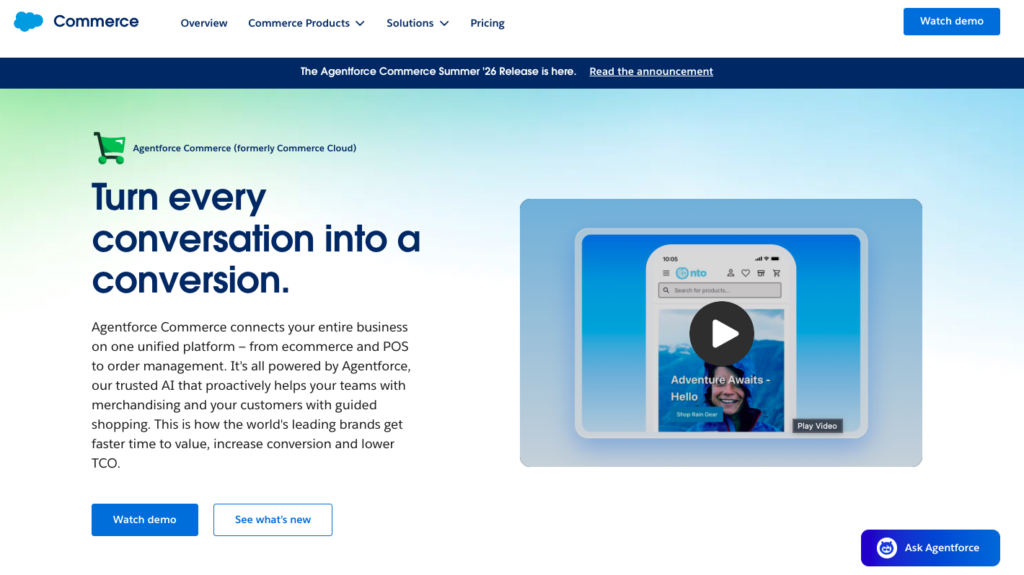
SCAPI provides mature headless primitives covering product browsing, cart management, and checkout, and Salesforce brings robust enterprise governance, identity, and abuse controls.
Best for: Enterprises already invested in the Agentforce roadmap.
Watch-out: Published evidence for shopper-agent protocols on the platform itself is limited, and the typical Salesforce installed base runs heavily customized checkouts that were never designed to be called by external agents. The capability exists, but most merchants have not switched it on.
Adobe Commerce (Magento)
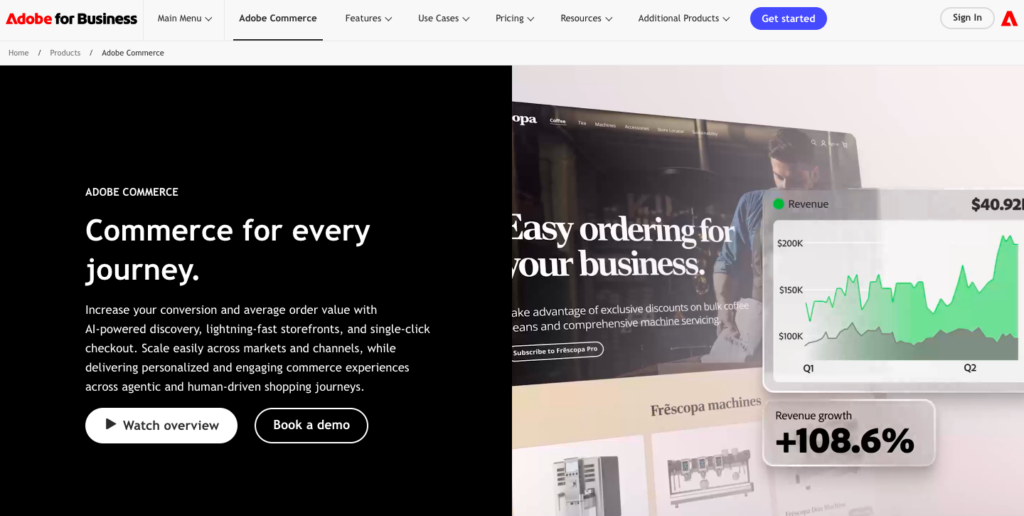
Adobe Commerce requires proper understanding, as headline assessments can be misleading.
The platform features robust machine-readable primitives via GraphQL covering cart, product, fulfillment, and pickup-location queries alongside mature REST support for headless and PWA storefronts. It is classified as a Contender because it lacks a documented shopper-agent protocol layer, rendering agentic commerce a custom build rather than a native configuration. Additionally, agent-specific payment evidence is absent, and schema support depends on themes or extensions.
Crucially, Adobe Commerce has publicly committed to supporting both UCP and ACP, expanding upon its previous AP2 support. This initiative aims to provide brands visibility across AI-driven shopping channels while retaining control over customer relationships, branding, and commerce data, with capabilities rolling out progressively through 2026.
Consequently, Magento lacks shipped protocol plumbing rather than core capability. Since this plumbing arrives in stages, merchants can achieve agent readiness today using a module instead of waiting for roadmap updates or replatforming.
Best for: Merchants with mature GraphQL implementations, strong integration capacity, and a preference for retaining control over their commerce data rather than relying on a hosted platform.
Watch-out: Without a protocol layer in place, agents can read your data but cannot complete a purchase.
WooCommerce
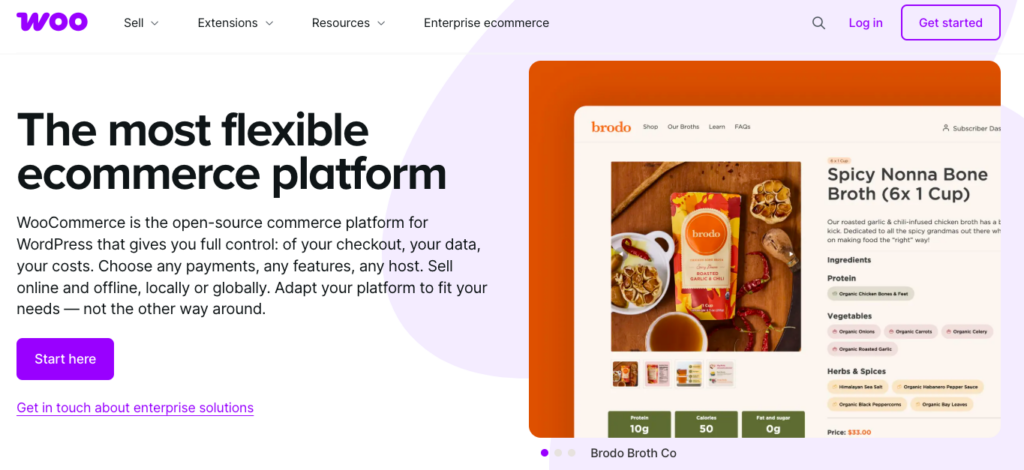
WooCommerce can be plumbed for agent operability by capable developers. The Store API exposes cart state and mutation endpoints, but cart operations need nonce or cart token handling that is awkward for external agents, and WordPress session models add fragility.
Best for: WordPress-native merchants with real plugin development capacity.
Watch-out: Tokenized agent payment is not in the default stack, and hosting and plugin variability create unpredictable agent behavior.
The Contender Pack: VTEX, Shopware, Spryker, OroCommerce, SAP Commerce
These platforms have credible API foundations and clear niche strengths, but share the same core gap. There is no public evidence of shopper-agent protocol support, no agent-specific payment rail evidence, and integration friction that compounds for agent use cases.
VTEX has documented headless cart and checkout through its Checkout API with strong regional payment depth in Latin America, though its orderForm model adds complexity for external agents. Shopware suits DACH composable mid-market but has non-trivial session handling when bridging headless to native checkout. Spryker is a strong European B2B fit with PSP-oriented payment flows. OroCommerce has one of the cleanest documented checkout APIs here, but relies on redirect-based payment completion, which limits agent autonomy. SAP Commerce offers a mature enterprise OCC REST layer, with implementation complexity that grows for agent use cases.
How to Choose an Agentic Commerce Platform
Not every platform that claims to be AI-ready is truly prepared for agentic commerce. Before making a decision, look beyond marketing claims and ask practical questions.
- Can an AI agent complete the entire purchase journey, including checkout?
- Does the platform support secure AI-driven payments?
- How easily can AI agents access product catalogs and pricing?
- Are there businesses already using these capabilities in production?
- Is the platform actively investing in AI commerce standards and integrations?
A platform should support more than product discovery. It should enable AI agents to search, compare, configure, and complete purchases without relying on manual intervention.
How to Make Your Store Agent Ready Without Replatforming
Replatforming is expensive, risky, and slow, and it trades away the control and customization that brought you to Magento in the first place. The gap between Adobe Commerce and the leaders is a protocol layer, not an architectural flaw. That layer can be added.
Here is the practical sequence:
- Clean up product data. Make sure descriptions, pricing, availability, and variants are structured, accurate, and available in real time. This is the foundation, and it is the priority for entering the agentic era.
- Expose a machine-readable catalog that agents can ingest, rather than relying on them to scrape your storefront.
- Serve a UCP profile at /.well-known/ucp so Google’s agents can discover your store and its capabilities.
- Make checkout programmatic, removing forced redirects from the agent path.
- Set up tokenized payment through a supported gateway so agents can pay without a human tap.
- Wire up order management and webhooks so status, shipping, and returns flow back to the agent.
- Test an actual agent purchase end to end, and keep testing after every deploy, since caching and indexing issues often break agent discovery in production.
FAQs
Which ecommerce platform is most ready for AI agents in 2026?
Shopify leads on documented shopper-agent infrastructure, with BigCommerce, commercetools, and Salesforce Commerce Cloud close behind. Most other major platforms are architecturally capable but have not shipped documented shopper-agent protocol support.
Is Magento agentic commerce ready?
Adobe Commerce has committed to supporting UCP and ACP, and those capabilities are rolling out through 2026. Until they ship in full, Magento merchants can become agent-ready now by adding a protocol module rather than waiting or replatforming.
What is the difference between UCP and ACP?
UCP is the Google-led standard that powers buying inside Google AI Mode and Gemini. ACP is the OpenAI and Stripe standard behind ChatGPT Instant Checkout. They serve different surfaces, so they are separate integrations.
Do I need to support both?
If you want to be present wherever agent-led shopping happens, yes. The protocols cover different consumer surfaces, and multi-protocol support is becoming the practical default rather than an edge case.
Is AI-enabled the same as agent-ready?
No. AI-enabled usually means internal merchant tools such as copilots and search assistants. Agent-ready means a third-party agent acting for a shopper can transact against your store. The vocabulary overlaps; the infrastructure does not.
Which AI agents are buying products in 2026?
The main consumer surfaces transacting today include ChatGPT through Instant Checkout, Google Gemini and AI Mode, Perplexity, and Amazon’s Rufus, with Claude transacting through MCP-based integrations. Coverage is uneven and changing fast.
Make Your Magento Store Agentic Commerce Ready
Platform choice is becoming a distribution choice. As AI agents steer shoppers toward agentic-ready stores, unprepared merchants risk losing future sales.
Magento merchants do not need to replatform to compete. While Adobe’s committed UCP and ACP support evolves, businesses can prepare ahead of wider adoption.
Meetanshi enables agentic readiness for Magento stores by implementing protocol support, optimizing product data, and integrating secure checkout flows, preparing businesses for next-generation ecommerce without platform migration.