Magento is a flexible PHP-based e-commerce platform used by all types of businesses. It’s been more than 14 years old, but it’s still popular.
To help you learn more about the platform and its position in the market, we gathered these interesting Magento statistics you should know in 2026.
Table of Contents
- Magento Usage Statistics
- E-commerce Market Share 2026
- Popularity of the Magento Platform
- Magento Extensions Statistics
- How Big is the Magento Ecosystem?
- Some Interesting Facts
But first, let’s see how it all started.
Brief History of Magento [Timeline]
Magento was co-founded by Roy Rubin and Yoav Kutner, who were working for Varien Inc. The platform was first released on 31 Aug 2007.
In the last 17 years, the Magento ecosystem has evolved drastically – from acquisition by eBay to a billion-dollar deal by Adobe. Here’s a timeline of how the Magento platform has evolved from 2007 to date.
| Year | Important Events |
| 2007 | Magento was born on 31 Aug 2007 (the beta version) |
| 2008 | The first stable version – i.e. Magento community edition was introduced on June 2008 |
| 2009 | The enterprise edition was released in April 2009 |
| 2010 | The founding company Varien Inc. renamed its osCommerce fork to “Magento” |
| 2011 | eBay acquired 100% shares of MagentoMagento Developer Certifications were introduced |
| 2012 | Magento created a new record of 4 million downloads |
| 2015 | Magento Commerce launched as an independent company backed by the Permira FundsMagento 2 was released on 17 Nov 2015 |
| 2016 | Magento Luma theme was releasedLaunch of Magento marketplaceMagento Enterprise Cloud Edition was launchedMagento partnered with Adobe |
| 2017 | Magento Community Edition became Magento Open SourceMagento Enterprise Edition became Magento Commerce |
| 2018 | Adobe acquired Magento on 21 Aug 2018 |
| 2019 | Introduction of Adobe Commerce CloudAmazon Sales channel was added to Magento |
| 2021 | Magento Commerce was rebranded as Adobe Commerce |
Editor’s Picks: Magento Statistics & Facts
- Magento (Adobe Commerce) is among the top ten most popular e-commerce platforms.
- In June 2024, the Magento platform is used by 130,044 live websites on the internet.
- On average, businesses on Magento grow three times faster than on any other platform.
- The Magento Open Source platform has been downloaded over 2.5 million times.
- In 2018, Adobe acquired the Magento platform for $1.68 billion.
- The Magento Open Source community is thriving with more than 480667 in the official Adobe forum.
- Every year, transactions worth $155 billion are processed in Magento stores.
Magento Usage Statistics
Magento Open Source is a platform for businesses looking to scale. It offers a flexible e-commerce platform that meets the needs of a growing business. Here are some Magento statistics on its usage and market popularity:
1. The Magento platform is used by 0.6% of all websites that use a CMS.
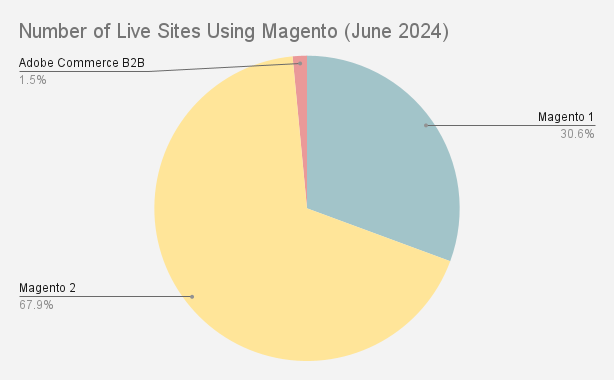
2. Magento is used by a total of 130,044 live websites.
3. Most of the Magento online stores, i.e. 88,253 sites are built using the Magento 2 version. On the other hand, only a fraction of Magento sites use the paid Adobe Commerce B2b edition.
4. The Magento Open Source is downloaded over 5,000 times every day.
5. A gross merchandise volume of $155 billion is transacted on the Magento Commerce Cloud platform every year.
E-commerce Market Share 2026
Magento 2 is an e-commerce platform used by businesses of all types for two main reasons. First, Its open-source codebase makes it a cost-effective solution for small businesses. Second, its high-end scalability allows enterprises to handle large volumes of orders and customize the platform according to their needs
Let’s see how the Magento platform compares to its competitors like Shopify and WooCommerce.
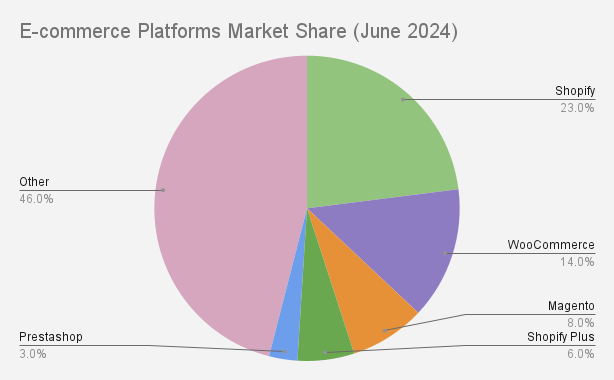
6. Magento is the third most popular e-commerce platform used by online shopping sites, after Shopify and WooCommerce.
7. The Magento platform holds 8% of the e-commerce market share, which means 8 out of 100 online stores are built using it.
Popularity of the Magento Platform
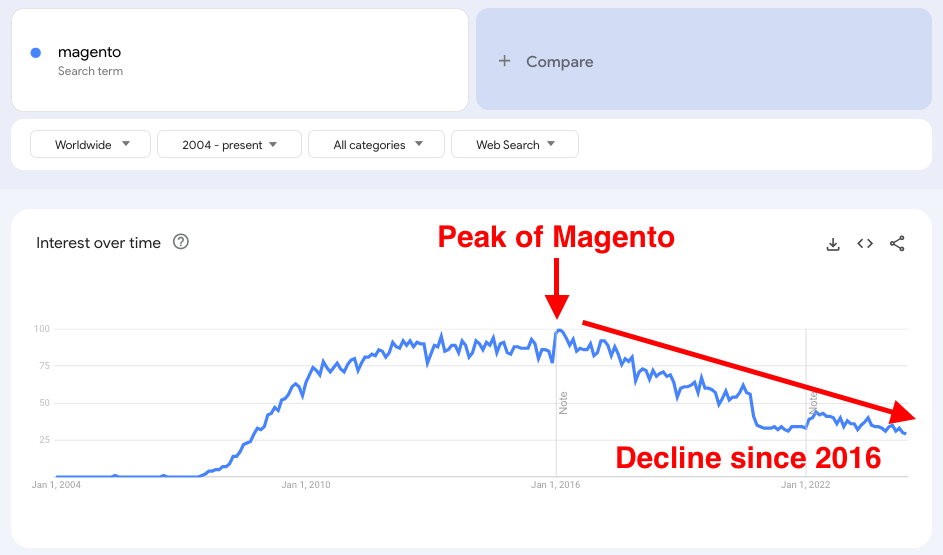
To analyze the popularity of the Magento platform, based on online searchers, I used the Google Trends data.
Google Trends show that Magento had a steep increase in popularity till 2016. However, the trend is reversed after that due to the introduction of alternate options like Shopify in the market. Here are some interesting insights:
8. In 2016, Magento was at its peak in terms of popularity.
9. Online searches related to the Magento platform have been on a decline since 2016, suggesting a negative trend in its popularity.
10. The USA, the UK, and the Netherlands are the top countries using the Magento platform right now. Here’s a breakdown of number of Magento websites by country:
| Country | No. of Magento Websites |
|---|---|
| United States | 42,965 |
| United Kingdom | 10,306 |
| Netherlands | 8,992 |
| Germany | 8,167 |
| Italy | 4,398 |
Magento Extensions Statistics
Users can extend the functionality of their stores with extensions or modules developed by third-party providers like Meetanshi. They list their extensions on the official Magento marketplace (now known as Adobe Commerce marketplace.)
11. There are 4470 extensions on the official Adobe Commerce marketplace that store owners can install to add new features.
12. You can also find 10 themes on the Adobe Commerce marketplace, out of which three are free to use.
The extensions help you fill the functionality gap in the store. For example, you can use Magento 2 Google Analytics 4 to set up e-commerce events tracking in your store to make data-driven decisions.
How Big is the Magento Ecosystem?
Magento has been reigning in the open-source e-commerce market since 2007. It has a rich community with thousands of developers and merchants around the world.
Here are some statistics that demonstrate the rich Magento community:
13. The official Magento community has more than 480667 active users with more than 210,000 posts.
14. Magento and Magento 2 are two popular communities on Reddit with over 11,000 combined users.
15. There are more than 168,000 Magento professionals on LinkedIn that are directly or indirectly reated to it.
16. Globally, there are more than 14,000 companies and agencies that provide Magento-related solutions.
The widespread community of Magento ensures that the users always have community-backed support. On top of that, Magento users can also opt for professional support from Adobe-certified experts. For e.g., Meetanshi offers Magento support and maintenance service to keep the operations running smoothly.
Some Interesting Facts
In love with the Magento platform? You’ll like these facts as well:
- Originally, the Magento platform was about to be named “Magenta” based on the color’s name. However, the co-founders decided to rename it to Magento since the magenta.com domain was already registered.
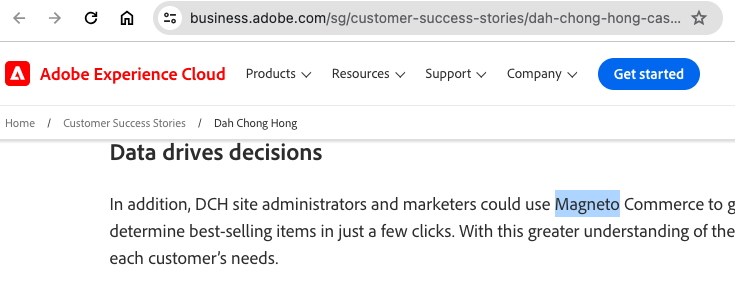
- I see this everywhere – Magento is misspelled as “Magneto”, which is a Marvel supervillain.
- Funny enough, even the Adobe Docs fail to spell it correctly sometimes (no editors were harmed here!)
- Based on number of monthly visitors, here are the top Magento stores:
- harborfreight.com
- sinsay.com
- reserved.com
- bouyguestelecom.fr
- nykaa.com
Popular Questions Related to Magento
Which Programming Languages Does Magento Use?
Magento is a PHP-based e-commerce platform. It uses the Zend Framework and the MVC (model-view-controller) architectural pattern.
What is the Latest Version of Magento?
The latest version is Magento 2.4.8. It was released by Adobe on April 9, 2024.
Will there be a Magento 3?
There is no official notification on Magento 3 from Adobe’s end.
Sources:
1. https://community.magento.com/
2. https://trends.builtwith.com/shop/Magento
3. https://trends.builtwith.com/shop/Magento-2
4. https://info2.magento.com/rs/585-GGD-959/images/Magento_Vs_Shopify_Comparison_Guide.pdf
5. https://commercemarketplace.adobe.com/extensions.html
6. https://community.magento.com/
7. https://www.reddit.com/r/Magento/
8. https://www.reddit.com/r/magento2/
9. https://www.statista.com/statistics/1430321/leading-websites-built-on-magento-by-traffic/