In Reddit communities, retailers debate Lightspeed POS versus Magestore for Magento and NetSuite setups, seeking a seamless Magento POS integration with NetSuite to unify operations.
This article dives into your tri-stack tech: Magento’s eCommerce role, POS for in-store sales, and NetSuite as the ERP on the back-end. We’ll clarify system functions and integration options, helping you decide the source of truth: Magento-first for agility or ERP-led for precision.
Understanding Your Technology Stack
To have a seamless Magento POS-Netsuite Integration, it’s important first to clearly understand the relevance of each piece.
1. Magento (eCommerce Backbone)

Magento would be your most stable eCommerce system for your online operation. It handles everything from your product catalog, dynamic promotions, and complex customer profiles, and quickly manages order processing to make everything run smoothly.
For developers, there are endless ways of adding additional flexibility through customizations. This will allow rapid scaling during peak traffic periods while incorporating B2B tools for different prices, quotes, and fully configurable prices.
Essentially, Magento is built for omnichannel strategies that integrate online and offline flows into one seamless operation for sustained growth.
2. Point of Sale (POS)

Your POS system runs every in-store activity, from product lookups, barcode scanning, promotions, customer management, to checkout and payment acceptance. It is the connection between your stores and your online Magento website, ensuring unified customer and inventory data across channels.
For omnichannel retailers building a Magento and POS tech stack, there are two primary connection models they will experience when connecting the POS to Magento.
- Magento-native POS (e.g. Magestore’s Magento 2 POS): Integrated directly into your eCommerce system. This allows real-time and accurate sync between online and offline channels and automatically updates orders and inventory without extra connectors.
- Magento non-native POS: A standalone POS solution (e.g. Lightspeed) that requires third-party connectors like Celigo to transfer or sync data between the POS channel and Magento. This approach will provide you with flexibility and choice of POS vendors while still maintaining consistent data across your online and offline channels.
3. NetSuite (ERP & Back-office Brain)

NetSuite serves as your ERP powerhouse for back office operations, providing control over core functions of your business in the cloud, powered by AI and real-time visibility.
It simplifies accounting and reporting, automates purchasing workflows, and allows employees to have visibility of inventory that exists in multiple stores. NetSuite also manages orders, fulfillment, and distribution across touchpoints, ensuring accuracy and efficiency throughout the supply chain.
Many retailers select NetSuite as the single most masterful system for accounting and item-master data, providing robust, accurate, and accessible single-version-of-the-truth across the organization.
To make the most of NetSuite’s centralized capabilities, retailers often seek POS systems that integrate seamlessly with it. If you’re exploring which POS platforms connect best with NetSuite, check out the full guide: POS for NetSuite.
What to Consider Before Integrating Magento POS and NetSuite?
Before implementing your Magento POS with NetSuite integration, you will have some intricate operating questions to answer.
Data Ownership & Mastership
Where does data actually live? Who owns it? Define which system is the single source of truth for products, pricing, customers, and inventory. For instance, NetSuite often acts as the financial and inventory master, while Magento handles customer-facing retail data. Clear ownership prevents overwrites, duplicate entries, and misaligned updates between systems.
Inventory Sync & Overselling
Inventory synchronization is often the most delicate part of any integration. Even minor delays can result in overselling or fulfillment errors.
Decide whether your stock levels should sync in real-time, in scheduled batches, or after specific triggers. Real-time sync ensures accuracy but can increase system load, so finding the right balance is key to maintaining seamless operations.
Customer and Company Mapping
A united customer profile is vital for loyalty and personalization. Ensure online and in-store data points align through consistent identifiers like email, phone, or unique IDs. When designing this mapping, consider: how will your systems recognize that the same person shopping online is the one making an in-store purchase?
Gift Cards, Store Credits, & Returns
These elements tie directly to customer trust and accounting accuracy. If a customer purchases a gift card online, can it be redeemed in-store immediately? Likewise, a return processed at the POS should update NetSuite instantly. Seamless handling of these financial items allows your employees and customers to see the same, accurate information.
Complex Order Routing (3PL, Marketplaces, Multi-Warehouse)
Your integration will also need to incorporate advanced order routing. You could be utilizing multiple warehouses, third-party logistics (3PL), or even shipping orders from marketplaces. This is where your NetSuite OMS comes into play, with iPaaS managing automation of splits and partials under observation. If you can succeed here, then you will have faster turnarounds with fewer mistakes.
POS Performance at Scale
Your POS should handle high-volume transactions without any slowdown, particularly during rush hours. Check if it can still process sales smoothly when the NetSuite connection lags or drops. Can it run offline, capture transactions securely, and sync them later without disrupting checkout? Ensuring speed, reliability, and offline resilience is key to maintaining a seamless customer experience.
How to Integrate Magento POS and NetSuite: Magento or NetSuite as the Source of Truth?
Ready to sync your tri-stack without the chaos? We’ll detail two proven models, starting with one that prioritizes front-end agility.
Model 1: Magento-First (Magento as the Hub)
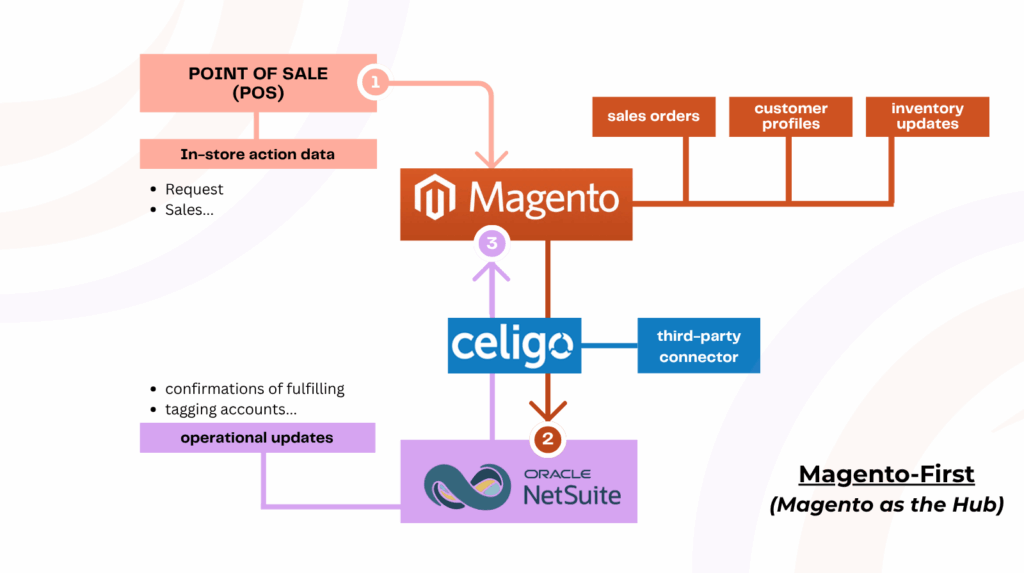
The Magento-First model puts your eCommerce platform at the center of all things transactional. It is the ultimate model for a Magento POS NetSuite integration for speed and user experience.
How it Works
Regard Magento as the central hub for your inventory, product catalog, and all sales channels. It controls what is in stock and where orders will be sent. Meanwhile, your POS directly connects with Magento without a 3rd-party connector, enabling fast in-store transactions, barcode scanning, and real-time updates without extra layers of sync.
NetSuite is downstream, handling the heavy-duty ERP functions like finances, accounting, and fulfillment. This keeps everything light and responsive for quick actions at the point of contact.
Data Flow
- POS → Magento: Requests and sales for in-store actions have all the data pushed to Magento instantly. This maintains accuracy in stock levels consistently.
- Magento → Celigo → NetSuite: Magento pushes sales orders, customer profiles, and inventory updates to NetSuite via a third-party connector, like Celigo.
- NetSuite → Celigo → Magento (Optional): NetSuite can push operational updates back to Magento (i.e. confirmations of fulfilling previous orders or tagging accounts).
Results
The key advantage is real-time inventory accuracy for both your POS and eCommerce. Magento also provides a clear view of any customer journey or order history. This enhances personalized shopping experiences. Finally, NetSuite provides accurate financial and operational data; however, it does not directly generate the core data reflected in Magento.
Pros
- Fewer process hops mean super quick inventory updates. Customers are constantly seeing accurate stock levels everywhere.
- It creates an incredible omnichannel experience between online and in-store, where one seems to inform the other.
- Magento’s reporting pulls it all into one area for good channel visibility.
Cons
- NetSuite won’t give you ironclad control, so watch out for duplicated data between systems.
- Using the ERP for challenging tasks like multi-warehouse management or in-depth accounting relies on the precision of Magento’s real-time inventory.
- Finally, if you’re using Magento POS with NetSuite sync issues, your NetSuite view gets outdated quickly.
Best For
This model works best for retailers and eCommerce-first businesses looking to create real-time inventory magic across channels with a great customer experience. It is a no-brainer if you are using a Magento-based POS like Magestore and want to keep the schedule evergreen and tailored to the NetSuite POS integration.
Model 2: ERP-Led (NetSuite as the Hub)
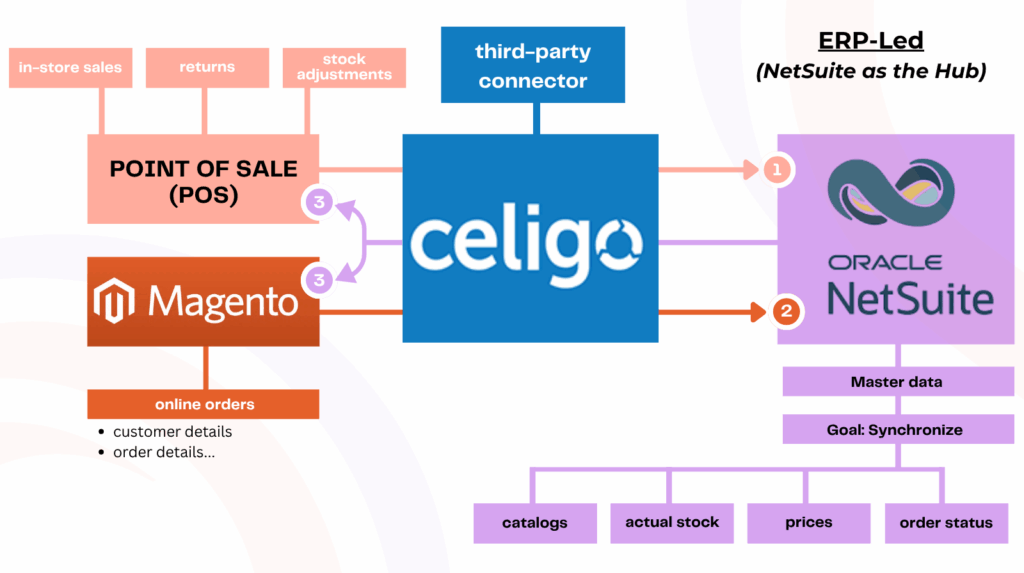
What if your back-office systems took the lead? The ERP-led model positions NetSuite as the single source of truth for uniform control. It suits Magento NetSuite integration in finance-driven configurations where accuracy matters more than speed.
How it Works
NetSuite functions as the central hub for core business data, including inventory levels, pricing, and accounting records. Magento and POS serve as sales channels that capture transactions but defer to the ERP. Updates from sales and stock go into NetSuite first for processing and then update the channels. This NetSuite POS connector approach provides consistency in data throughout the stack for scalable reliability.
Data Flow
- POS → Celigo → NetSuite: All in-store sales, returns, and stock adjustments flow to NetSuite via the connector for almost instant financial capturing.
- Magento → Celigo → NetSuite: All online orders flow directly into the ERP, without delay on customer and order details, keeping everything in sync.
- NetSuite → Celigo → Magento (and POS): Master data flows outwards to synchronize each other’s catalogs, actual stock, prices, and order status.
Results
NetSuite is the sole absolute source of truth for orders, stock, and transaction financials, while Magento appears to be the reality fed to it from its ERP, enabling no alternative discovery of order information for fulfillment outside the system. Your supply chain, operations, and accounting are all under one roof, being monitored, preventing discrepancies, and improving confidence for compliance.
Pros
- It provides solid financial management and compliance administration, maintaining fluid audits.
- The ERP handles precision well, mitigating mismatched records within your stack.
- It will scale effortlessly for complex B2B or wholesale environments with demanding stock.
Cons
- Adjustments to your customer-facing Magento take longer than the ERP sync cycle, so you may hold back on changing content on the site.
- Additional connection layers can make setup complex and create micro-delays in data transmission to your Magento instances.
- Reporting within Magento feels disjointed since almost all the action begins in NetSuite, not the customer-facing storefront.
Best For
This model is ideal for manufacturers, wholesalers, and ERP-driven retailers. It works for companies where accurate accounting and inventory are more critical than real-time aspects of the customer experience. It is also the only option if the business has a non-Magento POS, i.e. Lightspeed or Square, and needs to route sales through their ERP.
Lightspeed vs Magestore: Picking the Right POS for Your Magento-NetSuite Stack

Previously, we shared a Reddit community question about Lightspeed POS vs Magestore POS. These users look for the simplest means to seamless Magento POS NetSuite integration that unifies sales without endless tweaks. Let’s settle it by comparing these options head-to-head, focusing on fit and total cost of ownership (TCO) over 3-5 years.
1. Magestore POS + Magento + NetSuite
This setup thrives when Magento anchors your retail hub. It leverages native ties for smooth flows.
- Upfront Cost: Higher upfront license fee via the Commerce plan, but it skips layered SaaS subscriptions and extra connector charges.
- Integration Edge: Magestore embeds directly into Magento, cutting sync errors and lessening IT hours on fixes.
- TCO Breakdown: Lower long-term spend includes one-time Magestore POS license, no transaction fees (just processor charges), unlimited registers and users without scaling costs, free warranty/support after year one, and Magento NetSuite connector support (like Celigo).
Overall, it minimizes recurring middleware headaches for steady savings.
2. Lightspeed POS + NetSuite + Magento (via Celigo)
Go this route if NetSuite drives your operations as the backbone. It positions ERP control upfront.
- Upfront Cost: Lighter SaaS entry, yet recurring Lightspeed fees plus connectors cumulate rapidly.
- Integration Edge: Lightspeed runs standalone, so Celigo bridges to Magento and NetSuite. This adds vendor layers and potential failure spots.
- TCO Breakdown: Higher over time covers monthly Lightspeed subscriptions, transaction fees (higher with third-party processors), per-user/register extras, premium support services, Lightspeed-Magento connector, Magento NetSuite connector, and multi-vendor troubleshooting.
Align your choice with your source of truth. Pick Magestore for Magento-led agility and lower TCO. Choose Lightspeed for NetSuite dominance, despite the rising costs. Whichever you choose, you’ll still need a quality NetSuite Magento connector to smoothly fill the ERP chasm. With numerous options available, Magento NetSuite integration guide compares the top choices to help you select the optimal choice for your workflow.
How to Select the Right Magento POS & NetSuite Integration Model?
Your source of truth choice shapes every data flow in Magento POS NetSuite integration. It aligns ops, cuts errors, and boosts growth. Here’s what to take away:
- Master your stack: Magento drives eCommerce, POS facilitates in-store transactions (native like Magestore for seamless syncs, standalone like Lightspeed for flexibility), and NetSuite owns ERP finances.
- Weigh key factors: Tackle data ownership, inventory syncs, customer mapping, and scalability upfront to avoid oversells and chaos.
- Pick your model: Leverage Magento-first for omnichannel agility; go ERP-led for fiscal control.
- POS advice: Use Magestore + Magento Hub if real-time customer feedback tops your list—lower TCO, fewer errors. Move to Lightspeed + NetSuite backbone for compliance-heavy ops, despite higher ongoing costs.
Ready to unify your tri-stack? Contact Meetanshi for a tailored Magento NetSuite connector strategy today.