The quick commerce sector has rapidly transformed consumer behavior and the retail landscape, offering ultra-fast delivery of products. Here are key statistics on the market’s size, consumer demographics, and operational impact.
But, first let’s understand the difference.
Comparison: Quick Commerce vs. E-commerce
| Aspect | Quick Commerce | E-Commerce |
| Delivery Speed | 10-30 minutes | 1-5 days |
| Product Range | Limited; focuses on essentials | Broad; includes electronics, apparel, furniture |
| Operational Costs | High (due to dark stores & logistics) | Lower (due to centralized warehouses) |
| Market Value (2025) | ~$195.01 billion (Global) | ~$4.32 trillion (Global) |
Quick Commerce Statistics: Market Size & Forecasts
The quick commerce market is experiencing explosive global growth, with India being a significant growth driver.
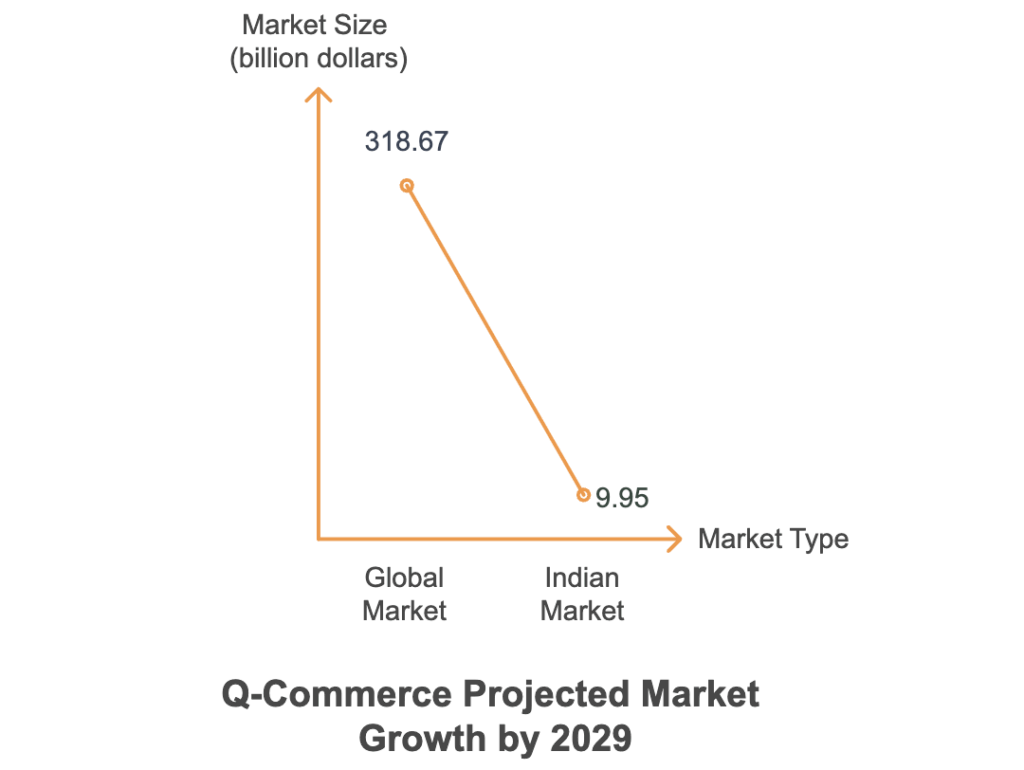
1. The Global market is valued at $104.1 billion in 2024, it’s projected to reach $318.67 billion by 2029, growing at a CAGR of 25.4%.
2. The Indian market grew by a staggering 280% over two years, from $0.5 billion in FY22 to $3.34 billion in FY24.
3. The Indian market is projected to reach $9.95 billion by 2029 and could hit $106.2 billion by 2033.
4. North America held the largest share in 2024, the Asia-Pacific region is the fastest-growing market.
Key Players in India Quick Commerce
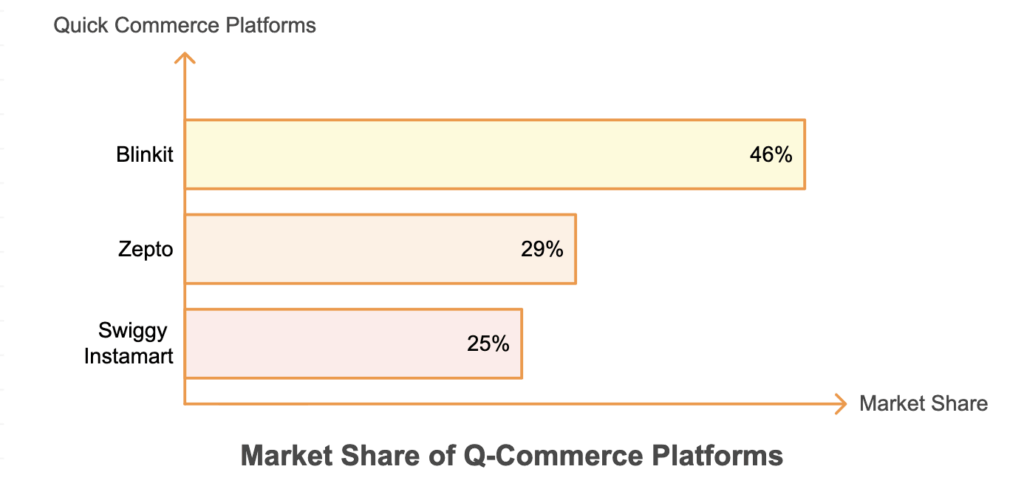
5. A few key players dominate the competitive Indian quick commerce landscape. Here is there market share (Q1 FY2025):
- Blinkit leads with a 46% market share.
- Zepto holds a 29% share.
- Swiggy Instamart has a 25% share.
6. Zepto’s revenue grew from ₹140 crore in FY22 to approximately ₹5,000 crore in FY24.
7. Swiggy Instamart’s Gross Order Value (GOV) increased by 58% year-on-year to roughly ₹8,100 crore.
8. Zomato invested ₹1,500 crore in Blinkit to expand its network of dark stores.
9. Flipkart allocated ₹3,249 crore to scale its Minutes network.
10. Reliance Retail achieved 2.4x order growth with sub-30-minute deliveries across 4,000 pin codes.
Quick Commerce Statistics: Demographics & Consumer Behavior
Quick commerce platforms are primarily used by young, urban consumers who prioritize speed and convenience.
11. Approximately 675 million people globally used quick commerce in 2025, a number expected to reach 900 million by 2029.
12. The primary user segments in India are the 25-34 and 18-24 age groups.
13. The user base is predominantly male, with Blinkit and Zepto having approximately 62.57% and 64.05% male users, respectively.
14. The percentage of frequent users who prefer online platforms for daily shopping has surged from 33% to 87%.
15. Quick commerce generates 6-8% of new, incremental demand in households that use it, boosting overall consumption.
16. Popular categories include ready-to-eat meals (42% usage) and salty snacks (45% usage).
17. 31% of urban shoppers rely on quick commerce for groceries, and 39% for top-up purchases.
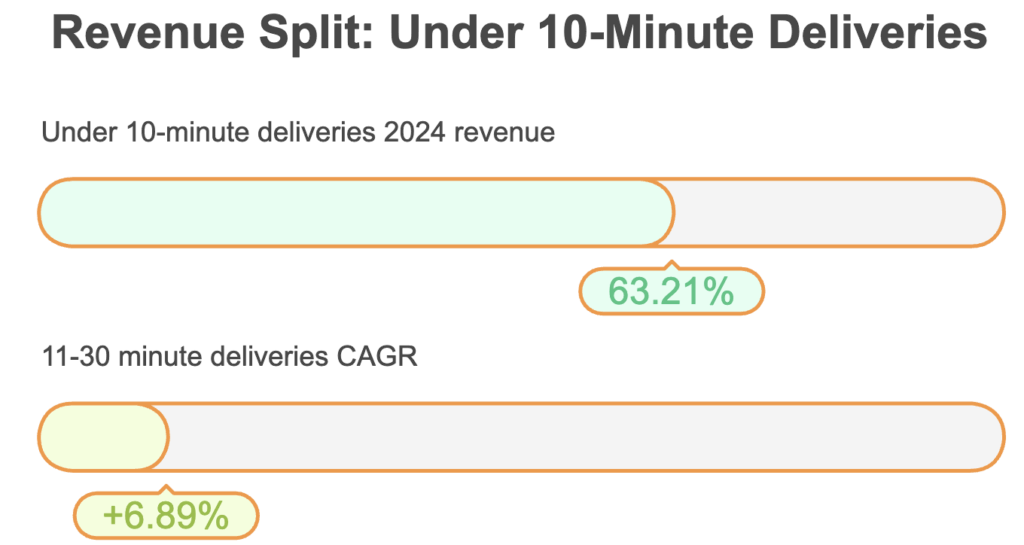
18. Under 10-minute deliveries account for 63.21% of 2024 revenue, while 11-30 minute deliveries are growing at a 6.89% CAGR.
Quick Commerce Statistics: Operations & Employment
The sector’s rapid growth has significant implications for employment and investment.
19. Quick commerce relies on hyperlocal dark stores serving a 2-3 km radius. The total number of dark stores in India is projected to reach 5,500 by FY26.
20. The quick commerce sector is projected to employ 500,000 to 550,000 people by next year.
21. Projections for 2025 indicate a 60% surge in gig worker hiring in the sector.
22. For non-food categories, it now captures 34-38% of retail investment. For food categories, it accounts for 23-25% of investment.
General Quick Commerce Statistics & Facts
23. This segment started in 2019 and has seen exponential growth, notably accelerated due to pandemic-driven consumer shifts.
24. The four major players dominating in India are: Swiggy Instamart, Blinkit, BB Now (Big Basket), and Zepto.
25. Orders delivered in under 10 minutes account for more than 63% of quick commerce revenue, establishing ultra-fast fulfillment as the sector’s hallmark.
26. Popular categories include 42% ready-to-eat meals and 45% salty snacks.
Wrapping Up
Quick commerce has fundamentally redefined last-mile logistics, forcing traditional e-commerce giants and conventional retailers alike to accelerate their delivery capabilities. The underlying expectation of speed—often under 30 minutes—is now the new baseline for convenience, ensuring that Q-commerce will remain a vital, albeit evolving, battleground in the digital economy.
The statistical narrative is clear: the instant economy is here to stay, and mastering the unit economics of urgency is the final frontier for market leaders.
Sources: Statista, Kearny, Chryseum, Business Research Company