When hiring a Shopify expert, a store owner’s common dilemma is to opt for a freelancer or a Shopify agency.
The right decision directly impacts the performance of your store.
In this blog, get insights and a comparison of a Shopify freelancer vs. an agency to choose the best help within your requirements.
Let’s begin with understanding the fundamentals.
Who Is a Shopify Freelancer?
A Shopify freelancer is an independent expert hired for specific projects.
They usually specialize in one area of the complete Shopify development, like developing a theme, optimizing the store, or improving Shopify SEO. They are a perfect, flexible, and affordable option for small or clearly defined tasks.
You can find and hire them from popular platforms like Fiverr, Upwork, Freelancer, and more.
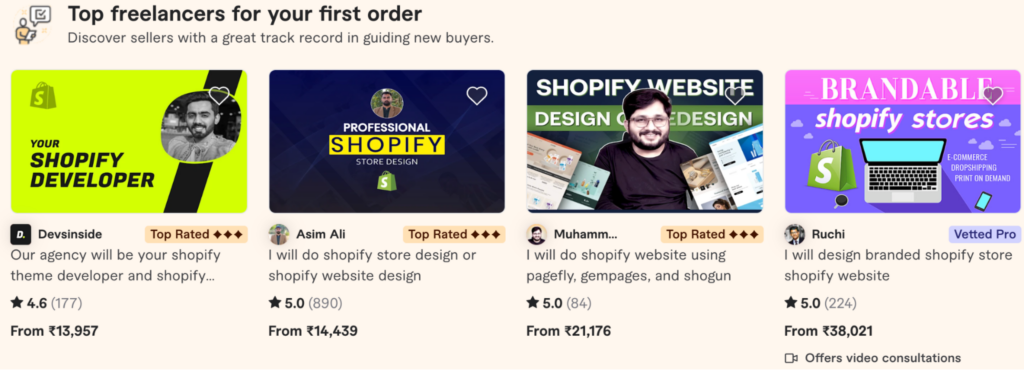
Image source: Fiverr
Their work generally falls into three aspects:
- Executes a clearly defined scope rather than owning your long-term business roadmap
- Focuses on specific deliverables
- Any additional tasks, revisions, or strategic consulting generally come with extra charges
What Is a Shopify Agency?
A Shopify agency is a full-service team of specialists.
The team includes developers, designers, marketers, and project managers, who provide end-to-end solutions. They provide a clear process and support for complex projects, long-term strategy, and continuous store expansion.
Image source: Meetanshi
Their key responsibilities are:
- Operates with structured, well-defined processes
- Works through a coordinated team of specialists
- Provides long-term guidance and support
Compared: Freelancers vs. Shopify Agency
Here is a detailed comparison between hiring a Shopify freelancer and an agency.
| Factors | Shopify Freelancer | Shopify Agency |
| Best For | Specific tasks & small budgets | Full builds & scaling brands |
| Project Cost | Lower (Direct rates, no overhead) | Higher (Includes management & QA) |
| Deadlines | Faster for small, agile fixes | Structured & reliable for large projects |
| Expertise | Expertise is limited to one person | Access to a multi-skilled team |
| Support | Often project-based; limited availability | Long-term maintenance |
| Specialization | Niche or specific skills | Broad Shopify & e-commerce speciality |
Project Cost
Freelancers are generally more budget-friendly compared to agencies.
Because they have fewer indirect costs, and you only pay for the specific hours they work. Agencies cost more, but this covers extras like project management and quality checks that help avoid major problems.
While the total cost to hire a Shopify expert depends on your project’s scope, agencies often offer better long-term value for complex builds by creating a more reliable, scalable base.
Deliverable & Deadline
For small, quick tasks like a theme tweak, a Shopify app setup, or a single-page design, a freelancer is usually the faster and more cost-efficient option.
They can jump in quickly, work independently, and deliver focused tasks without the overhead of agency processes.
However, for large-scale builds, full store setups, custom development, complex integrations, or long-term SEO/marketing, a Shopify agency becomes the safer and more reliable choice. Agencies have multiple specialists, so if one person is unavailable, others can continue the work without disrupting timelines.
Ultimately, the ideal choice depends on your deliverable:
- A freelancer or agency can work fast on smaller tasks, but agencies may feel expensive for simple jobs
- For bigger projects, agencies provide continuity, expertise, depth, and structured workflows, reducing the risk of delays caused by a single point of failure
Project Expertise
Freelancers specialize in coding or design, so for complex projects, you need to manage several. An agency provides all the necessary experts working together, resulting in a more unified outcome.
Complex Shopify stores need different specialists (UX, backend, API, performance, CRO). If you use freelancers, you have to manage and coordinate all of them, which can mean more communication hassle and potential for errors.
Agencies provide all the experts, developers, designers, strategists, and testers who collaborate with proven methods. This delivers a better, more unified product, a smoother process with less management for you, and a guarantee that your store functions perfectly.
Support & Maintenance
Freelancers might disappear after the project is done. Agencies, however, provide ongoing, structured support with guaranteed teams to manage bugs, updates, and security checks.
Shopify stores always need ongoing support and maintenance (updates, fixes, troubleshooting). Freelancers often handle this only when needed, meaning inconsistent support and variable response times.
Agencies offer structured, reliable support, often through retainers. This includes guaranteed response times, dedicated teams, and regular handling of bugs, updates, and performance checks, providing stability and peace of mind.
Specializations
Freelancers are ideal for small to mid-sized tasks (theme setup, code fixes, speed boosts) as they are fast, affordable, and specialized.
However, their limited individual expertise makes them unsuitable for large, complex projects like advanced APIs or multi-store setups, which would require managing multiple freelancers, increasing workload and cost.
Agencies are better for big, complicated jobs like moving to Shopify Plus, making custom apps, setting up headless commerce, and linking systems (ERP/CRM). They have teams to handle many complex tasks simultaneously, which is too risky for one freelancer.
Shopify Freelancer: Pros & Cons
It is wise to understand the areas of strength and weakness of each before you decide to hire a Shopify specialist. They help you better decide and keep an open mind about areas where they might struggle to meet your needs.
| Elements | Pros | Cons |
|---|---|---|
| Cost & Budget | Generally a more budget-friendly option for most businesses. | Scaling may eventually require a costlier transition to an agency. |
| Communication | Direct access to the expert; no “middleman” or extra team members. | You must act as the Project Manager, setting all deadlines. |
| Efficiency | Simple tasks are finished quickly without losing quality. | Offered services often have a limited scope of work. |
| Commitment | Work is project-based; once the task is done, the engagement ends. | Responsibility for quality control rests entirely on your shoulders. |
Freelancers are usually a budget-friendly option, which makes a lot of difference. Because the tasks are simple, they can quickly finish them off without compromising the output.
Additionally, you also get to talk directly to the expert, as there is no other team member involved in this process. As the task is completed, your work with them is done.
However, with a freelancer, you also become the project manager, setting deadlines and ensuring quality. As your store grows and technical needs become more complex, you will likely need to switch from a freelancer to a more capable agency.
Shopify Agency: Pros & Cons
Hiring a Shopify agency means getting a whole team for your store’s growth. It costs more but is reliable and strategic.
| Elements | Pros | Cons |
|---|---|---|
| Team & Expertise | Access to a ready-made team of designers, developers, and marketers. | Higher costs due to overhead, management, and specialized tools. |
| Reliability | Diverse teams ensure continuity even if one member is absent. | Formal processes can result in slower project starts. |
| Project Scope | Best for complex projects (Shopify Plus migrations, global expansion). | Their formal approach can be overkill for small tasks. |
| Management | Includes Project Managers and QA testers to handle the details. | Communication goes through a PM, which can slow down technical talks. |
| Added Value | Provides long-term strategy and business advice beyond just code. | Generally requires a significantly higher budget than freelancers. |
Agencies are better suited for complex projects like Shopify Plus migrations and large global expansions, as they use project managers and QA testers. They also offer long-term strategy and business advice, not just coding.
Agencies often charge more due to their budget burden, management, and tools. For small tasks, their cost and formal approach can be too much.
Checklist for Hiring a Shopify Expert
Use this checklist to vet your options and ensure your project stays on track and delivers a high ROI:
- Look for live stores that match the complexity and design aesthetic you want for your own brand
- Make sure they know Liquid (Shopify’s code), the Shopify API, and the newest OS 2.0 tools
- Look for feedback specifically regarding their communication, reliability, and ability to meet deadlines
- Ensure they use professional project management software (like Trello, Asana, or Jira) so you can track progress easily
- Clarify if they offer a warranty period for bug fixes or ongoing maintenance packages after the project goes live
- Ask how they handled a specific technical challenge in a past project to gauge their strategic thinking
- Ensure the contract clearly states that you own all code, assets, and login credentials upon completion
- Avoid false estimates; ask for a cost breakdown by feature or milestone to prevent budget overruns
How to Hire a Shopify Expert?
Hiring the right expert is a multi-step process that begins long before you look at a portfolio. To find a partner who can truly scale your business, follow this structured roadmap.
Prior you prepare for this process, it’s best to understand the basic things to consider before hiring a Shopify developer, such as defining your specific technical needs and setting a realistic budget.
Define your scope & goals
Before contacting anyone, clearly document your requirements by creating a brief project discovery outline that defines whether you need a basic theme setup, a Magento-to-Shopify migration, or a custom app, along with must-have features like subscriptions, multi-currency, or ERP integration.
Source potential candidates
Instead of relying solely on Google searches, use trusted channels like the Shopify Expert Directory for certified partners, platforms such as Clutch or Upwork for verified reviews, and Shopify communities or meetups to find experts actively involved in the ecosystem.
Verify their Shopify skills
A good developer isn’t enough, you need a Shopify specialist skilled in Liquid, Online Store 2.0, and API integrations for connecting third-party tools.
Match their portfolio to your vision
Look for projects similar to yours and check their live sites for mobile responsiveness and page speed, especially if your store has complex or high-volume requirements.
Conduct a strategic interview
Move beyond asking “Can you do this?” and focus on “How would you do this?” by discussing scenarios like handling SEO redirects during a migration or testing changes before launch, questions like these, often covered in curated Shopify interview questions, help you evaluate real expertise and process depth.
Finalize the agreement
Never start a project without a clear contract in place. It should define feature-based payments tied to deliverables, include post-launch support such as a 30-day bug-fix period after go-live, and clearly state that you retain full ownership of all code and assets.
Frequently Asked Questions
Which Option is More Budget-friendly?
Freelancers are typically more affordable due to lower overhead and direct hourly rates.
For long-term scaling, is it better to work with a Shopify freelancer or an agency?
An agency is better for long-term scaling because it offers a full team and the resources to support growing technical needs as your business expands.
Should I hire an SEO agency or a freelancer, and how do I decide?
Use a freelancer for one-time audits or fixes, and an agency for ongoing, comprehensive SEO growth strategies.
Shopify Expert Agency vs Freelancers: Final Decision
Hire a freelancer for fast, cheap fixes, or an agency for full growth, reliability, and complex projects. Freelancers are quick, but agencies offer a full team and resources to scale a big brand without issues.
At Meetanshi, we combine the best of both worlds, delivering specialized Shopify solutions with the reliability and professionalism of an agency. We can help with custom app development, migrations, and store optimizations to help you scale all with budget-friendly plans.