Customer retention focuses on building trust, delivering consistent value, and creating positive experiences that encourage loyal customers to repurchase.
Successful retention comes from understanding customer needs, offering personalized experiences, and maintaining strong communication. In short, it’s about turning first-time buyers into lifelong brand supporters.
Let’s look at some interesting customer retention statistics in e-commerce.
Key Customer Retention Statistics 2025
- The average customer retention rate in eCommerce stands at around 26%.
- 82% of customers feel that a company’s values should align with their own.
- 39% of shoppers said they would permanently stop buying from their favorite brand if its values don’t align with theirs.
- 24% of shoppers would temporarily stop buying from the brand if values don’t match.
- 28% of consumers share their concerns with family and friends, which can significantly impact customer retention.
- Similarly, 15% of consumers prefer posting their grievances on social media, which can damage reputation.
- 77.1% of respondents said they would keep shopping with a brand that uses data analytics and tech-driven strategies.
- Nearly 80% of consumers are more likely to do business with a company that offers personalized experiences.
- Triggered emails for custom retention get opened 95% more often than mass emails.
- Brand loyalty is a strong factor for many consumers, with 77% of those surveyed identifying as loyal to specific retailers, brands, or stores.
- A decrease in product quality can lead to customer churn, as 57% of consumers have switched brands for this reason.
- Cost is a major factor in customer loyalty, with 60% of consumers having switched from a brand they were loyal to because of price considerations
- 44% of Gen Z have switched brands based on sustainability practices, compared to just 16% of Baby Boomers.
- A negative customer experience leads to 52% of consumers having switched from a brand they were loyal to because of one.
- 88% of consumers remain if the business invests in a good onboarding content.
Customer Retention Statistics Across Industries
Customer retention stats vary greatly from one industry to another, as each sector has its own customer expectations, buying patterns, and competitive pressures.
Understanding these differences helps businesses recognize what drives loyalty in their specific market and adapt strategies accordingly. Ultimately, it’s about knowing your audience and meeting their needs consistently to build lasting relationships.
- The media and the professional service industries both have the highest worldwide customer retention rate at 84% each.
- The insurance and automotive/transportation industries come next with 83% customer retention rates, followed by the IT services industry and healthcare with a rate of 81%, and construction and engineering with an 80% retention rate.
- The industry with the lowest customer retention rate was hospitality, travel, and restaurants, with 55%.
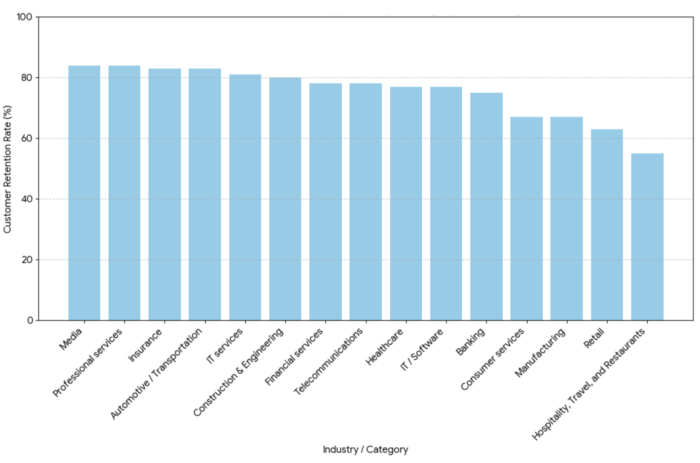
Customer Retention Statistics across Industries.
Customer Retention Programs Statistics
Loyalty programs help boost customer retention by creating ongoing reasons for customers to stay engaged and return.
They reward repeat purchases with points, discounts, or exclusive perks, fostering a sense of value and emotional connection with the brand. These programs encourage customers to buy more frequently and often, increasing their lifetime value.
Additionally, they create regular engagement opportunities that keep the brand top-of-mind, turning casual buyers into loyal advocates.
- 70% of consumers worldwide considered themselves loyal to certain retailers, brands, or stores.
- For over 30% of consumers, brand loyalty was rooted in trust, love, and genuine devotion.
- 90% named trust as a brand purchase criterion, while 85% mentioned loving the brand.
- 40% of consumers agreed that a good loyalty program still positively influences their likelihood to stay loyal to a brand, but is not the only major factor.
- In the U.S.A., 50% of surveyed shoppers in 2025 felt generally positive, to far more positive about a brand due to its loyalty program.
- Small business organizations, specifically 66%, do not have a loyalty program in place, with only 34% utilizing one.
- The loyalty programs that do exist in small businesses are primarily digital, accounting for 46%, while others are paper-based at 31% or verbal/other forms at 17%.
- Brands with strong loyalty programs are more likely to be recommended, as confirmed by 70% of consumers in a recent survey.
- To maximize the benefits of loyalty programs, 63% of consumers are willing to change their spending habits.
- 87% of loyalty program members are open to having their behavior monitored in exchange for personalized rewards and engagement.
- The use of loyalty programs is on the rise, with 28% of consumers using more programs in 2024, a notable increase from 20% in 2023.
Customer Retention Statistics by Churn Rate
Customer churn stats focus on understanding how many customers stop doing business with a company over a specific period.
Churn rate is a key metric that indicates the percentage of customers lost, helping businesses identify patterns, causes, and areas to improve retention efforts.
Here are some of the most important customer retention statistics by churn rate.
- Almost half of subscribers (49%) say that discounts are the biggest factor in convincing them to keep their subscription.
- Among 14.2 million U.S. consumers considering canceling a subscription, 51.7% said they would opt for a pause feature instead.
- Between 20% and 40% of customer churn is caused by payment card failures, which can be reduced by keeping payment details up to date.
Impact of Customer Retention on Business Statistics
Customer retention directly impacts a business’s long-term growth, profitability, and brand reputation. Loyal customers buy more, cost less to maintain, and often bring in referrals. Strong retention reduces churn and creates a stable revenue base.
We will now look at some customer retention stats supporting the above assertion.
- Up to 84% of customers are more likely to remain loyal when they have a positive experience, rather than simply receiving a product replacement.
- 93% of consumers are willing to buy again from companies that provide outstanding customer service.
- A small 5% increase in customer retention can boost profits by up to 95%.
- Selling to existing customers has a 60–70% success rate, compared to only 5–20% for new customers.
- Returning customers spend 67% more over time than first-time buyers.
- For small businesses, repeat customers are a major source of income, with 61% generating the majority (51% or more) of their annual revenue from this group.
- Small businesses prioritize retention, with 62% allocating the majority of their annual marketing budget to keeping existing customers, while a smaller portion is dedicated to acquiring new ones.
Summing Up
Customer retention plays a vital role in building long-term business success.
Focusing on delivering value, creating memorable experiences, and building genuine connections can turn one-time buyers into loyal advocates. Add retention strategies in your marketing plan and build quality relationships.