Most Shopify store owners don’t think about address validation…until orders start bouncing back, customers complain, and shipping costs quietly bleed profits.
If you’re running a growing store in 2026, especially with international or high-volume shipping, a Shopify address validator isn’t a “nice to have” anymore. It’s basic hygiene.
I’ve worked with Shopify brands across industries — fashion, DTC, B2B, subscriptions — and the pattern is always the same:
Bad addresses = failed deliveries, angry customers, wasted time, and money down the drain.
So let’s fix that.
In this guide, I’ll walk you through:
- What a Shopify address validator actually does (and what it should do)
- Why this matters more in 2026 than ever
- The Real impact of fake or incorrect addresses
- Why Shopify alone doesn’t fully solve this
- A practical example (No theory)
- 5 best Shopify address validators 2026
- How to choose the right one for your store (without overthinking it)
No fluff. No app-store hype. Just real, practical advice.
What Is a Shopify Address Validator
A Shopify address validator checks customer shipping addresses before an order is placed or fulfilled.
It typically:
- Detects incomplete or incorrect shipping addresses before payment
- Flags missing postal or ZIP codes and mismatched city/state entries
- Prevents checkout when required address rules aren’t met
- Blocks fake or placeholder address entries used to rush checkout
- Stops orders with restricted address types, such as P.O. boxes
- Enforces country or region-based shipping address rules
- Prompts customers to correct address errors in real time with clear guidance
Think of it as a gatekeeper. Instead of discovering problems after the order ships (or fails), you catch them right at checkout.
And yes — that difference matters more than you’d expect.
Why Address Validation is Critical for Shopify Stores in 2026
Shipping in 2026 isn’t forgiving. Carriers are stricter. Delivery windows are tighter. Customer patience is…limited.
Here’s what I see most often when stores skip address validation:
- Orders contain address errors
- Re-shipping costs quietly stack up
- Support teams spend hours fixing preventable mistakes
- Refund requests increase, even when it’s not your fault
Now flip that. Stores using a solid Shopify address validator usually see:
- Fewer failed deliveries
- Lower shipping adjustment fees
- Faster fulfillment
- Better customer trust (this one’s underrated)
And if you ship internationally? Honestly, it’s not optional anymore.
The Real Impact of Fake or Incorrect Addresses
This is where things get expensive.
From working with Shopify stores, incorrect addresses usually lead to:
- Failed or delayed deliveries – Carriers don’t “fix” bad data anymore. They return it or charge more.
- Extra shipping fees & adjustments – Address corrections, rerouting, or re-labeling isn’t free.
- Support overload – Your team spends time emailing customers for corrections instead of growing the business.
- Refunds & reshipment – Even when it’s the customer’s mistake, stores often absorb the cost.
- Lower customer trust – Customers remember delivery issues more than smooth orders.
Individually, these issues seem small. At scale, they quietly eat margin.
Why Shopify Alone Doesn’t Fully Solve This
Shopify does a great job capturing address data.
But here’s the limitation: Shopify doesn’t enforce address quality by default.
- Required fields can still contain junk
- Checkout allows incomplete but technically “filled” addresses
- There’s no native logic to block risky combinations
- Validation is formatting-focused, not intent-focused
So while the checkout looks clean, bad data still slips through.
This is where additional control becomes important.
In order to take full control of the buyer’s journey, many merchants look into broader Shopify checkout customization to add security and trust signals beyond just address fields.
A Practical Example (No Theory)
Consider a Shopify store shipping to multiple countries. They notice:
- Most delivery failures come from missing postal codes
- International customers skip required details
- Support spends hours chasing corrections
Instead of fixing orders manually, they add checkout rules that:
- Block orders without postal codes
- Prevent checkout when address fields are incomplete
- Require corrections before payment
What changes?
- Failed deliveries drop significantly
- Support workload reduces
- Fulfillment runs smoother
- No changes to pricing or shipping logic
Same store. Same traffic. Fewer problems.
5 Best Shopify Address Validators 2026 (Free & Paid)
1. Blockit: Checkout Validation – All-in-one Address Validator (Free)
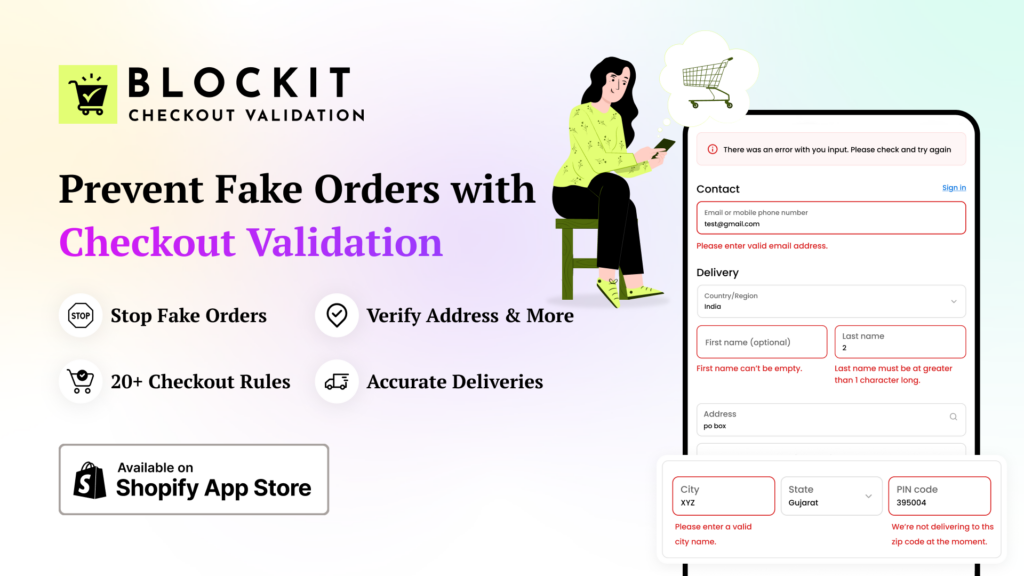
Blockit is one of the most useful Shopify checkout validation and address validator apps built to stop fake orders before they reach payment. It validates shipping addresses, emails, phone numbers, and checkout details in real time to ensure only genuine orders go through.
With 15+ smart checkout validation rules, Blockit lets you block checkout for invalid email or phone numbers, missing full names, P.O. box addresses, incorrect address formats, restricted customer tags, excessive discounts, cart mismatches, high order totals, and more. You can also restrict specific pincodes, countries, and cart attributes.
Blockit helps Shopify merchants reduce failed deliveries, prevent fraud, and maintain clean order data by validating everything at checkout — not after the order is placed.
Key Features:
- Real-time validation of shipping addresses, email IDs, and phone numbers at checkout
- Address-based checkout blocking to prevent incomplete, fake, or restricted deliveries
- Rules based on customer details, cart contents, order value, and shipping information
- Ability to block P.O. box addresses, specific countries, or unsupported regions
- Custom global error messages that clearly explain why checkout is blocked
- Works seamlessly with Shopify’s native checkout, without replacing the checkout flow
- 24/6 customer support available.
Pricing: Free
2. Address Validation iO (Paid)
If you’ve ever had an order fail because of a missing house number or a mistyped email, you already know how small input errors turn into big operational headaches. Most customers don’t mean to enter bad data — they rush, autocomplete fails, or mobile keyboards betray them. The problem is, Shopify still lets those orders through.
It checks shipping addresses and email IDs during and even after checkout, helping merchants catch issues before orders are processed. Instead of discovering problems at fulfillment or customer support stages, stores can prompt customers to correct mistakes instantly.
Key Features:
- Real-time address validation with smart suggestions during or after checkout
- Detects missing house numbers, invalid ZIP codes, and restricted address types like P.O. boxes
- Email validation to identify mistyped or non-deliverable email addresses
- Automatically tags orders with address or email issues for faster internal handling
- Quick setup with no coding required; works across all Shopify themes and plans
- Fully GDPR and CCPA compliant to protect customer and merchant data
Pricing: First 500 orders free, $0.045 per order thereafter
3. VL: Checkout Address Validator (Paid)
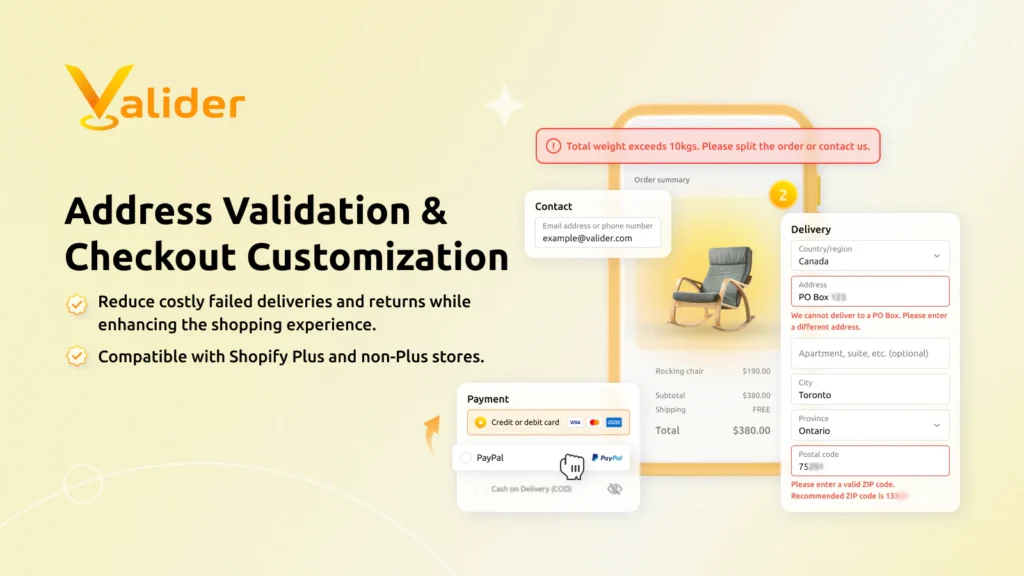
Failed deliveries usually don’t start in the warehouse. They start at checkout — missing apartment numbers, ZIP code mismatches, P.O. boxes slipping through, or customers rushing on mobile. By the time fulfillment teams notice, the cost is already locked in.
The app combines address validation with checkout customization rules, allowing merchants to validate shipping and billing details in real time while controlling how checkout fields behave. Instead of reacting to bad orders later, stores can guide customers to enter accurate information upfront.
Key Features:
- Instant validation of shipping and billing addresses during the checkout process
- Automatic address rules for P.O. boxes, USPS formatting, military addresses, and ZIP mismatches
- Checkout rules based on order value, products, or selected shipping options
- Advanced checkout customization to hide, rename, or reorder fields as needed
- Fully customizable checkout prompts and error messages to match brand tone
Pricing: $0.04 per order validated by Valider
4. Address Ninja ‑ Validator (Paid)
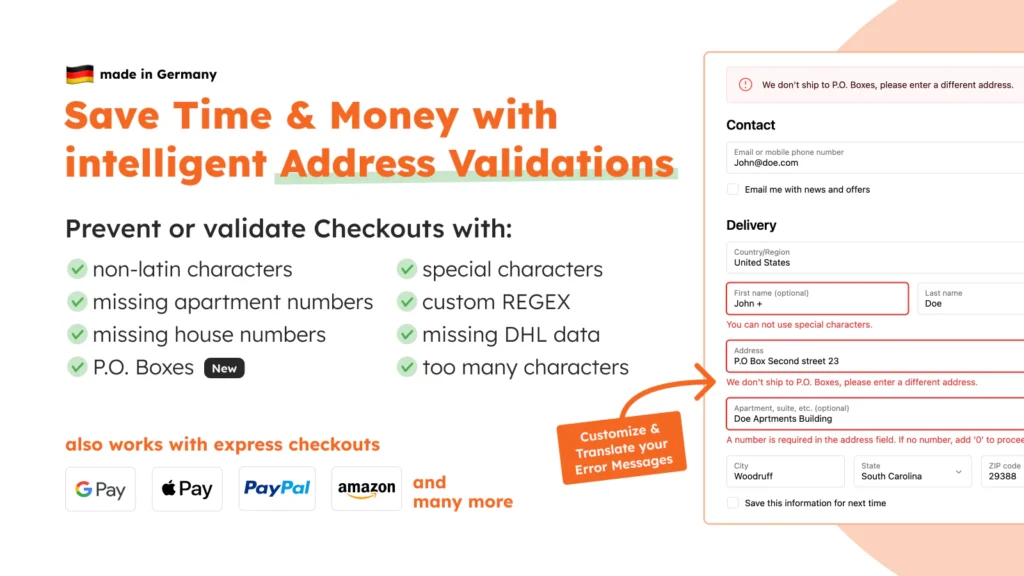
Undeliverable packages are rarely caused by couriers. Most of the time, the issue starts with address formatting — missing house numbers, P.O. boxes slipping through, or special characters that break shipping systems. Merchants usually find out only after an order fails, when fixing it already costs time and money.
The app takes a stricter approach to address validation. Instead of suggesting corrections, it actively blocks checkout when address rules aren’t met. If a customer enters an address without a house number, uses restricted characters, or tries to ship to a P.O. box, checkout simply doesn’t continue. This helps merchants avoid fulfillment delays and reduces manual follow-ups with customers.
Key Features:
- Blocks checkout when addresses contain non-Latin or unsupported special characters
- Prevents all P.O. box addresses using strict address validation rules
- Requires a valid house number and street name before checkout can continue
- Works on all Shopify plans, not limited to Shopify Plus stores
- Validates addresses even during express checkout flows like PayPal, Apple Pay, and Google Pay
Pricing: Starts $4.99/month
5. Address Guard Address Validator (Paid)
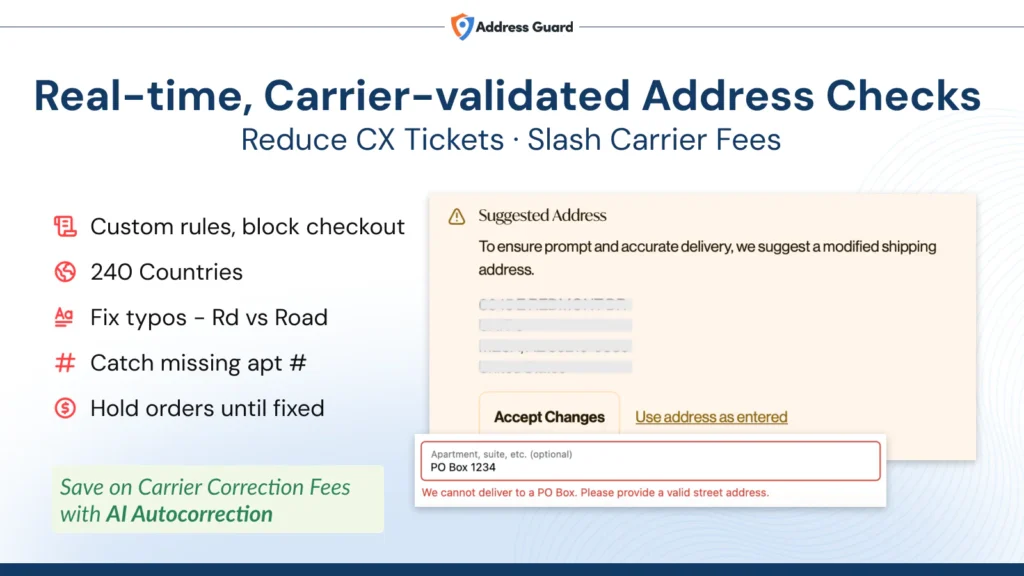
Most address validators check formatting. AddressGuard goes a step further by validating addresses directly against carrier databases. That difference matters when failed deliveries come with real costs — including carrier correction fees that can quietly eat into margins.
The app adds real-time, carrier-validated address verification at checkout, with the option to replace Shopify’s default Google Autocomplete entirely. It catches small but costly errors — “Rd” vs “Road”, missing apartment numbers, or undeliverable address formats — and fixes them automatically before an order moves forward. For merchants shipping at volume, that can mean fewer failed deliveries and fewer surprise carrier charges.
Key Features
- Real-time, carrier-validated address verification across all Shopify plans
- Optional Autocomplete replacement for Shopify Plus stores
- Blocks undeliverable addresses like P.O. boxes, missing apartment numbers, and invalid characters
- Holds problematic orders before they reach fulfillment and tags them for internal workflows
- Built-in email and phone number verification to improve overall data quality
- Works seamlessly with express checkouts like Shop Pay, Apple Pay, Google Pay, and PayPal
Pricing: First 100 orders free, $0.04 per manual validation or $0.06 per autocomplete validation across 240+ countries thereafter
How to Choose the Right Shopify Address Validator
The best address validator depends on where your store loses time or money. If most issues happen at checkout, real-time validation is essential to stop incorrect addresses before the order is placed. If problems appear later—failed deliveries, carrier surcharges, or customer follow-ups—post-checkout checks help, but they don’t prevent friction.
For many stores, address validation alone isn’t enough. Invalid phone numbers, fake emails, PO boxes, restricted locations, or rule-breaking orders can still pass through checkout. That’s why Shopify merchants increasingly choose apps that combine address validation with advanced checkout validation rules, giving them control over what can and cannot be submitted.
When evaluating an app, look for:
- Real-time address validation at checkout
- Flexible rules (PO boxes, missing fields, countries, order value, cart items)
- Compatibility with Shopify’s native checkout and express payments
- Custom error messages that guide customers instead of blocking blindly
Apps like Blockit fit this approach by validating addresses while also enforcing checkout rules across customer, order, and cart data—helping stores prevent bad orders without hurting conversions.
Final Thoughts
Shipping issues rarely come from one small mistake. They usually come from a mix of incomplete addresses, invalid inputs, and checkout gaps that slip through unnoticed. While Shopify provides the basics, growing stores need stronger validation to protect margins, reduce support load, and keep customers happy.
Choosing the right solution means looking beyond simple address checks. Tools that combine address validation with smart checkout rules give merchants better control and fewer surprises after orders are placed.
In the long run, stopping invalid orders early is one of the simplest ways to improve fulfillment, reduce costs, and scale with confidence.
Frequently Ask Questions
1. What is a Shopify address validator?
At its core, it’s a way to sanity-check shipping addresses before an order gets placed. Instead of finding out later that an address is missing details, the validator catches it right at checkout.
2. Why do Shopify stores even need address validation?
Wrong addresses aren’t rare, They’re constant. One missing apartment number or bad ZIP code turns into failed deliveries, re-ships, and support emails nobody planned for. Address validation cuts those problems off early.
3. Doesn’t Shopify already validate addresses?
Sort of—but not in the way most store owners assume. Shopify collects address fields, yes. But it doesn’t really stop customers from entering nonsense or half-complete details. Apps fill that gap.
4. Can address validators actually stop fake orders?
In many cases, yes. Especially the better ones. They block things like placeholder addresses, P.O. boxes, invalid emails, or rushed test orders before payment ever goes through.
5. Are Shopify address validator apps expensive?
Usually not. Some are free or have generous limits. Paid tools tend to charge per order or a small monthly fee, which is often cheaper than dealing with failed deliveries later.