eCommerce POS is turning retail operations by connecting online and offline stores. Despite their potential, many businesses have yet to leverage these tools entirely.
Reports indicate that 73% of consumers shop across multiple channels, but only a few retailers offer a unified commerce experience regardless of channel. That gap represents a big opportunity to enhance operational efficiency and customer experience.
Moreover, an effective eCommerce POS will assist in integrating retail channels at both the digital and physical levels, meeting customer expectations. In fact, customers who shop across multiple channels have an estimated 33% higher lifetime value than single-channel shoppers. As a result, it highlights the importance of a unified approach.
So, if you’re looking to fine-tune your operations and be competitive, choosing eCommerce POS is very important. This analysis will probe into the top 4 eCommerce POS systems that effectively link online and offline stores.
Read more!
What is eCommerce POS Integration?
eCommerce POS integration is the digital solution providing smoother data flow between POS software and other eCommerce platforms. This system enables companies to integrate offline and online channels into a retail ecosystem cohesively.
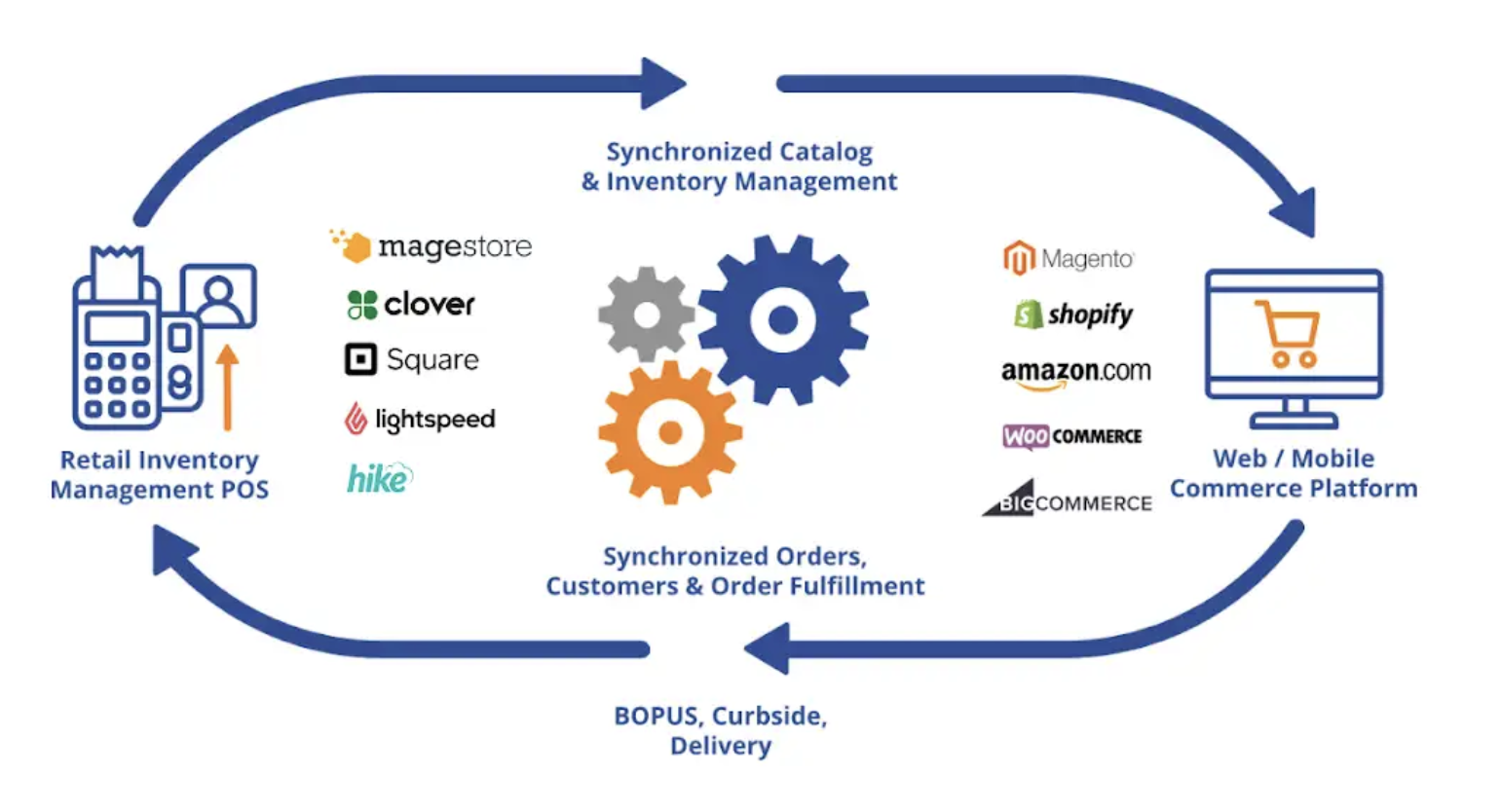
The main key benefit of this integration lies in its ability to unify business operations. Therefore, retailers can manage their inventory, raise prices, lower them, and even holistically take orders, regardless of whether the transaction occurs in-store or online.
Additionally, the consolidated data and insights from eCommerce POS integration will deliver business owners and managers the clear visibility they need to make smart decisions across their entire retail operation.
That sort of perspective — heavy with a bird’s eye view — holds immense value when it comes to strategic planning, inventory management, and spotting growth opportunities in both the physical and digital channels.
7 Benefits of Integration POS and eCommerce Platform
For multi-channel selling retailers, POS integration with eCommerce is paramount. This solution is core and most important to two business types:
- Businesses having only offline stores: These businesses are looking to scale their operations online and need a trustworthy eCommerce platform to help them develop their online presence.
- Businesses having offline and online stores: Until now, these businesses have managed their offline and online stores independently. They often rely on manual data entry, which leads to inefficiencies and errors. That’s why these merchants are looking for a POS solution that seamlessly merges both channels to manage all data in a single place.
This is where both groups can turn to great use with the help of POS and eCommerce integration. Here are the seven key benefits of POS system for eCommerce platforms:
1. Sell Everywhere at Once
As your business grows, you’ll want to sell through more channels — whether it’s adding a new online store, selling through 3rd-party marketplaces (eBay, Amazon,…), or opening another physical location.
With POS integration, managing these multiple sales channels becomes simple and centralized. Moreover, You can quickly add a new sales channel through a POS integration API. From then on, merchants can easily track sales, inventory, and customer data, no matter how many places they’re selling from.
2. Smoothly Handle Orders from Every Channel
Today’s customers want speed and reliability when filling orders. With every one of your stores treated as a fulfillment center, integrating your POS with your eCommerce platform guarantees you can process orders quickly and accurately.
Whether they pick up in-store or have their orders shipped, you will be delivering seamless, hassle-free experiences one after another.
3. Say Goodbye to Manual Data Entry
Manual data entry is a pain. It’s slow, error-prone, and sucks up so much of your time. However, with an eCommerce POS system, you manage everything from inventory to customer orders in one place, and the information is synchronized automatically across online and offline channels.
No more manual updating again, no errors — just continuous automated processes that free you up to focus on more important things.
4. Keep an Eye on Stock and Avoid Over-Selling
Knowing what you have in stock at all times is crucial. With real-time inventory tracking through POS integration, you can see what’s selling and not across all your sales channels.
This helps you avoid running out of popular items and getting stuck with products that aren’t moving. You’ll always be ready to meet customer demand and keep your shelves stocked with the right products.
5. Run Promotions and Discounts Across All Channels
Setting up discounts and promotions can be a hassle, especially when applying them online and in-store.
From the moment you have eCommerce POS in hand, business owners can create and manage promotions across all channels with just a few clicks. Be it a store-wide sale or a special offer for online shoppers, you can keep your marketing efforts consistent and efficient.
6. Get to Know Your Customers Better
We all know that understanding your customers is the key to business growth. The point-of-sale integration with the eCommerce platform gives you a complete view of customer behavior on each channel.
After that, these insights help provide personalized marketing efforts and drive wiser decisions in retaining those customers.
7. Make Shopping a Breeze for Your Customers
Customers today expect flexibility. They want to shop online, pick up in-store, or return items in any way that suits them. With a POS system integrated with your eCommerce platform, you can offer these seamless experiences effortlessly.
In addition, you’ll have all their shopping data in one place. Hence, eCommerce POS allows you to personalize promotions and build stronger customer relationships.
How to integrate POS with an eCommerce Platform
There are two most common ways of POS integration with an eCommerce platform:
Method #1: Standalone POS Integration
In this case, you will use the POS as a standalone system that allows integration with various eCommerce sites. For example, you are working as a merchant on multiple sites, like Shopify and WooCommerce.
If the standalone POS can integrate with all of those independently, it will let you connect your independent POS to each one. Yet, this approach may involve additional costs of integration services or third-party solutions that tie everything together.
Method #2: Inbuilt with POS Integration
Some POS systems are natively developed to integrate with many eCommerce platforms out of the box. For example, Magento POS by Magestore is native to Magento, meaning it is built specifically for that platform and doesn’t require additional integration.
On the other hand, Shopify POS by Magestore is also natively integrated with Shopify, whereby once set up, everything comes along perfectly without any extra effort in integration.
These solutions are “native” to their respective platforms, which means they work seamlessly with the eCommerce system right out of the box. The significant advantage is that no additional integration services are needed. Everything fits together smoothly, which can help reduce overall costs.
4 Best eCommerce Integration Solutions
The right POS system to integrate with an eCommerce platform will help smooth operations and provide a fantastic experience for customers. Next, we will discuss the four best eCommerce pos system solutions, highlighting varying strengths and considerations to consider in every case.
1. Magestore POS: Ideal for Magento and Shopify Merchants
Magestore POS is built natively for Magento and Shopify, so it works seamlessly without extra tools or third-party connectors. This native setup makes installation simple, reduces costs, and ensures accurate real-time sync across all stores and locations.
The system is designed for speed and reliability, letting cashiers complete orders in under one minute and continue selling offline with automatic sync when the internet is restored. It also supports true omnichannel retail, enabling merchants to manage multiple stores, run loyalty programs, and handle fulfillment all in one place.
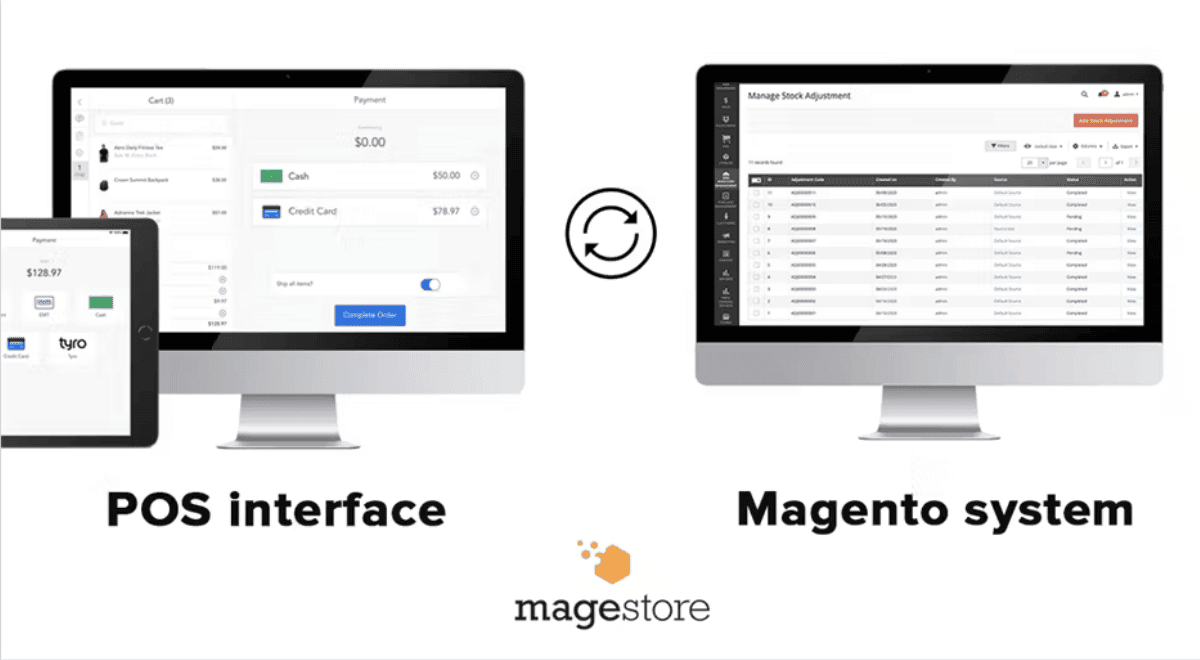
Magestore POS is compatible with common hardware, including iPads, tablets, PCs, receipt printers, and barcode scanners, enabling retailers to utilize their existing devices and reduce costs. With unlimited locations, registers, and users included at no extra charge, the solution is fully customizable and scalable to grow with your business.
Key features:
- Sync all data in real-time across locations and sales channels
- Accept various payment methods, including cash, cards, split payments, “buy now, pay later,” and reward points
- Easily connect with payment providers like Authorize.net, Stripe, Tyro, PayPal, and more
- Speed up checkout to reduce customer wait times
- Offer self-checkout services and customer-facing displays for faster transactions
- Handle refunds, returns, and exchanges smoothly
- Track inventory across all locations and transfer stock quickly from one dashboard
- Sell seamlessly across multiple channels and marketplaces with omnichannel fulfillment options
- Enable loyalty programs like reward points, store credits, and gift cards across all channels
- Get live, accurate reports for data-driven decisions
- Operate smoothly whether online or offline – no internet required
- Customize and scale features to meet your unique business needs
Transaction fees:
- Magestore doesn’t charge transaction fees. These fees depend on your payments.
Pricing:
- Magento POS Lite
- Only $69/month
- 7-day free trial
- Unlimited locations, users, and devices
- Magento POS Commerce
- Custom quote
- Free 1-year support
- 90-day refund policy
- Unlimited users and devices
- Shopify POS Lite
- Only $15/month/1 location
- Free 30-day trial
- Shopify POS Standard
- Only $50/month/1 location
- Free 30-day trial
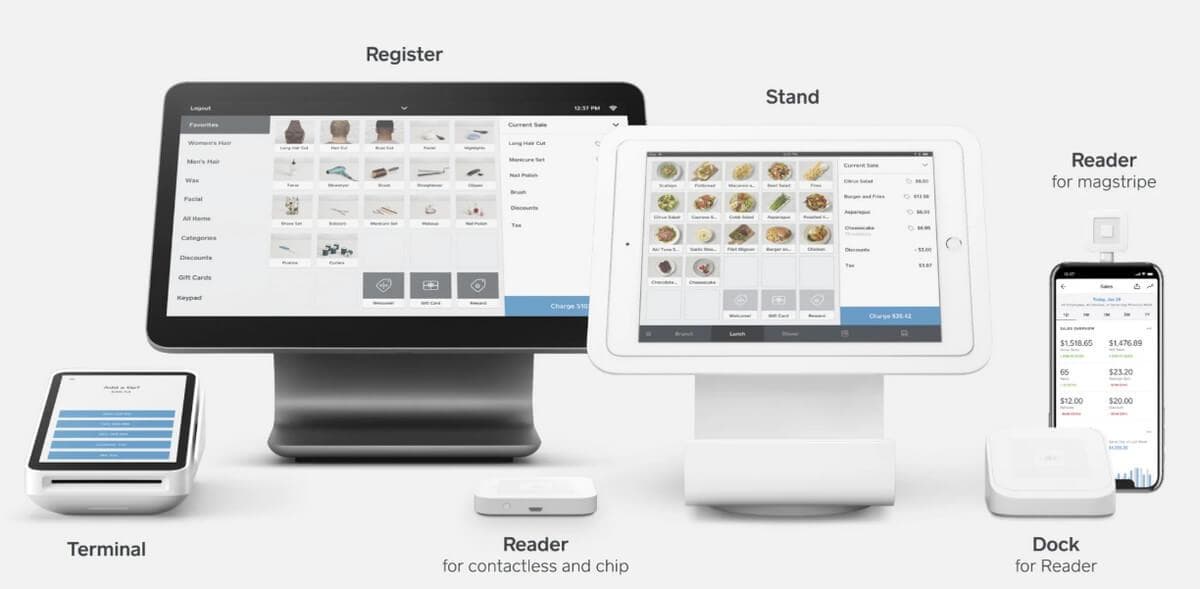
2. Square POS: Best for Startups and Small Businesses
Startups and small businesses prefer Square POS because it is an all-rounder, easy to operate, and affordable. One of its unskippable features is Square Online, which helps companies quickly build online stores. This sets it aside as a great choice for new businesses to establish an online presence quickly.
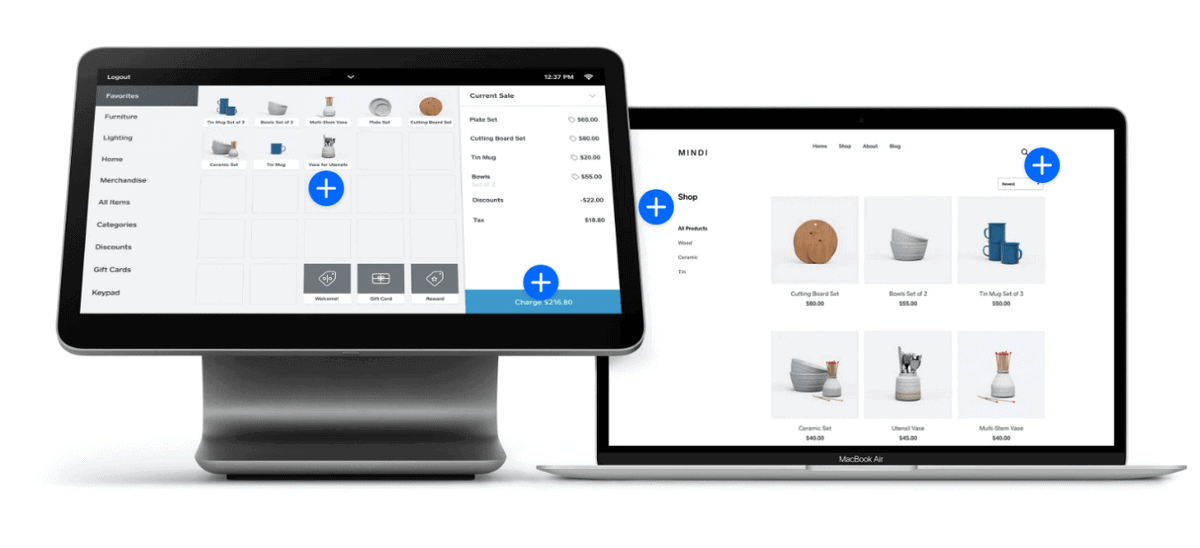
Still, if you already have a website running, integrating with Square POS requires third-party services, such as Magento, Shopify, and WooCommerce. Of course, those extra services come at additional fees, and the integration won’t be as safe as native solutions allow. In addition, while Square POS has good functionality, its support and synchronizing capabilities are still limited.
Key features:
- Accept online orders for in-store or curbside pickup
- Offer a variety of payment options like cash, contactless, chip, Cash App, buy now pay later, cards on file, gift cards, and checks
- Quickly process refunds and automatically update stock levels
- Upload unlimited items to your inventory
- Track inventory in real-time across all your locations and online stores
- Set up alerts for low-stock items
- Access inventory reports and forecasts to stay ahead
- Automatically create customer profiles, groups, and custom fields with every plan
- Get unlimited personal passcodes, time tracking, timecard reporting, and multiple wage rates
- Advanced Access offers customizable permission sets starting at $35/month
Transaction fees:
- In-person transactions: 2.6% + 10¢ per sale
- Online transactions: 2.9% + 30¢ per sale
- Manually keyed transactions: 3.5% + 15¢ per sale
- Invoices: 3.3% + 30¢ per sale
3. Lightspeed POS: Best Flexible Standalone POS for eCommerce
Another standalone solution is Lightspeed POS. This eCommerce POS works with nearly every eCommerce platform out there, which gives great flexibility to companies with diverse needs. Whether using Magento, Shopify, or WooCommerce, merchants can integrate it with their eCommerce platform through Lightspeed’s services or by purchasing a third-party connector.
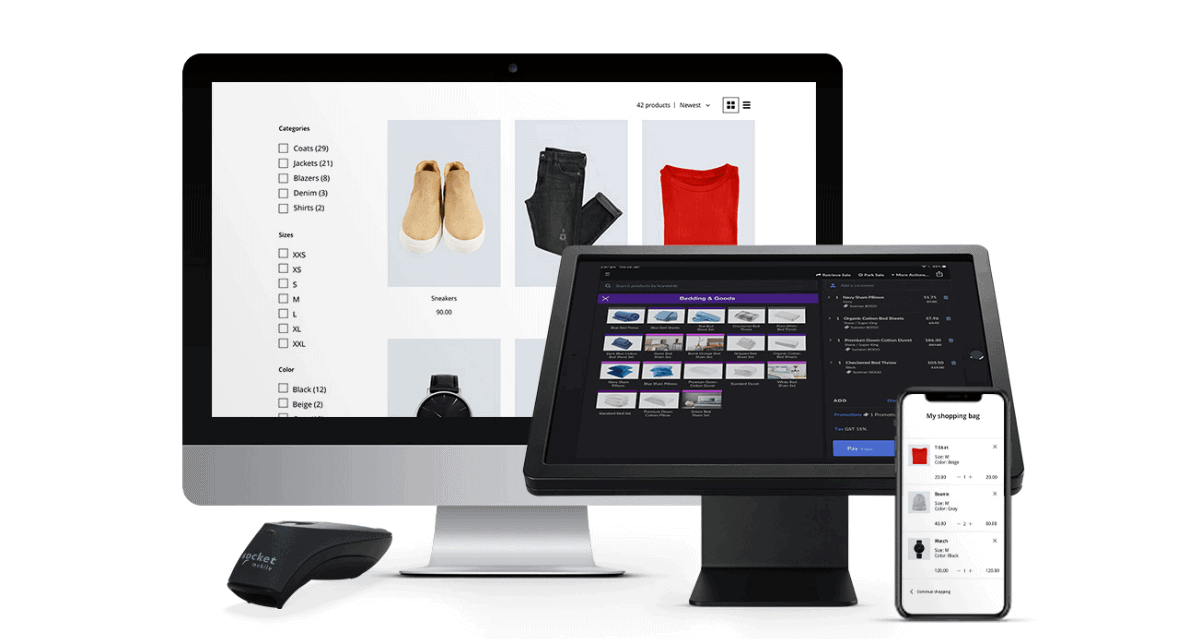
However, there are some drawbacks to this flexibility. Lightspeed POS integration can be expensive, especially when third-party services are required.
Similar to Square, Lightspeed offers its website builder, Lightspeed eCom. While pricier than Square, it provides a more comprehensive, holistic solution. Businesses with existing websites might find that native solutions offer better synchronization and support.
Key features:
- Connect with payment gateways like Authorize.net and PayPal
- Easily add and move stock between stores
- Sync price adjustments and automatically reorder inventory
- Set up recurring transactions and automatic billing for your customers
- Generate customer gift cards that can be redeemed for rewards
- Unify sales data in one dashboard, making it easy to manage multiple stores from one place and export reports to CSV files
- Track and log employee hours to simplify payroll and keep vital employee records like pay rates and start dates
- Quickly create and assign tickets to track external and internal issues
Transaction fees:
- Card-present transactions: 2.6% + 10¢ per sale
- Card-not-present transactions: 2.9% + 30¢ per sale
4. Clover POS: Best eCommerce POS Solution for Customization
Clover POS is the last contender for best POS and eCommerce integration. This is an all-in-one system that scales with any changing business needs. Among other characteristics, it is highly customizable to correspond to every business’s unique operational demands.
One respect in which Clover is impressive is the ability to work with nearly any eCommerce website. You can use various built-in integration options or third-party connectors for more advanced configurations.
Whereas flexibility is one of the strong points of this feature, it’s also worth mentioning that it might drive further costs and eventually create problems with smooth synchronization between them.
Key features:
- Accept a wide range of payment methods, including credit cards, debit cards, contactless payments, and mobile wallets like Apple Pay and Google Pay
- Easily track and manage inventory in real-time across all locations
- Set up and manage employee shifts, track hours, and generate payroll reports
- Create and manage customer loyalty programs, including reward points and gift cards
- Customize your POS system with a wide range of apps and integrations available through the Clover App Market
- Generate detailed sales reports and analytics to gain insights into your business performance
- Offer online ordering and curbside pickup options for customers
- Process refunds and exchanges smoothly while automatically updating inventory
- Manage multiple locations from a single dashboard, including transferring stock between locations
- Provide flexible hardware options, including countertop, handheld, and mobile devices
Transaction fees:
- Card-present transactions: 2.3% + 10¢ per sale
- Online or keyed-in transactions: 3.5% + 10¢ per sale
The Bottom Line
The right choice in eCommerce POS helps bridge the gap between your online and offline stores to ensure a unified experience for you and your customers. As discussed above, some of the most popular eCommerce POS solutions — Magestore, Square, Lightspeed, and Clover have different strengths tailored to meet various business needs.
As a business owner, take some time reviewing these options to your needs and goals so that in the future, you may be able to opt for something that makes doing business much more accessible. An ideal POS system for an eCommerce platform will transform how you do business, making it much easier on your side. It will also deliver an excellent experience to the customers.
Apart from that, if you are looking for an extended scope of eCommerce solutions, Meetanshi offers expert services tailored to your business.
Contact us for custom assistance and consultation to take your retail game to the next level. Thank you for reading!