If you already run promotions, the real question isn’t whether to bundle. It’s which bundle structure fits the goal you’re chasing, and how to build it on Shopify without eroding margin or overselling inventory.
This guide walks through six bundling strategies that work on Shopify, what each one is best for, and how to set it up. We flag the Shopify-specific constraints that decide whether you can use the native tools or need an app.
It’s written for merchants past the basics who want to choose a bundle type on purpose rather than copy a competitor. First, the evidence that bundling is worth the effort, then the strategies themselves.
Why Product Bundles Work
Bundling isn’t just a merchandising hunch. It has been studied directly, and the research shows a real revenue effect when the structure is right.
In a Harvard Business School study of Nintendo’s handheld console market from 2001 to 2005, offering a console-and-game bundle alongside the option to buy each item separately raised total hardware sales by roughly 100,000 units and lifted game sales by more than one million units, compared with offering no bundle at all. Revenue rose on both the hardware and the software side.
The same study found that structure matters more than the bundle itself. When the set became the only way to buy, revenue fell by more than 20% versus the flexible approach, and unit sales dropped by millions. Bundles worked when they added a choice, not when they removed one.
Watch out: Selling a set as the customer’s only option (“pure bundling”) can backfire. Keep the individual products buyable on their own, and treat the bundle as an extra path to purchase.
Why does the flexible version work? It sorts customers by price sensitivity, so budget-minded shoppers take the discounted set while others buy the pieces separately, and it pulls purchases forward instead of letting shoppers wait for a later price drop.
The takeaway for your store: run bundles alongside your individual products, not instead of them. The same researchers noted that letting customers assemble their own set could perform even better, which is exactly where the strategies below come in.
6 Best Bundling Strategies for Shopify
Here are six bundle types worth running on Shopify, each matched to the goal it serves best. Pick the one that fits your objective rather than launching all six at once.
1. Fixed Bundles (curated kits and sets)
A Fixed Bundle is a set you assemble yourself and sell as one product at one price, usually at a small discount versus buying each item separately.
Best for: raising AOV with a curated set, guiding first-time buyers toward a complete solution, and moving a slow SKU by pairing it with a bestseller.
You control the exact contents, so a Fixed Bundle is the most predictable way to lift order value. A skincare store can sell a “Morning Routine Set” of cleanser, serum, and moisturizer at 10% off the combined price, turning a one-product purchase into a three-product one.
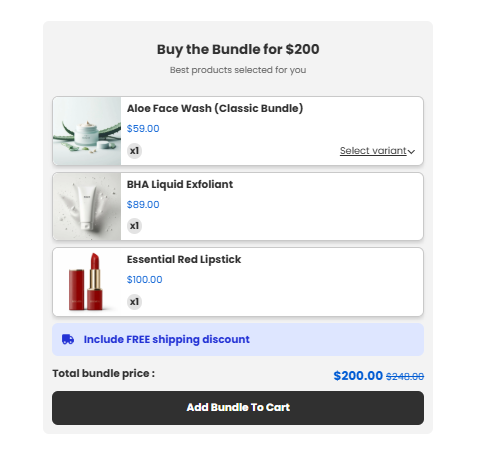
On Shopify: this is the one bundle type Shopify handles natively. The free Shopify Bundles app creates fixed bundles and multipacks and keeps component inventory synced in real time.
Tip: Name the bundle by the outcome it delivers (“Morning Routine Set”), not by its contents. Then show the combined individual price next to the bundle price so the saving is visible at a glance.
Watch out: Don’t discount so deeply that you train customers to wait for the set. Keep the individual SKUs attractive on their own, and treat the bundle discount as a nudge, not the main reason to buy.
Next step: pick one high-intent product and build a set around it that answers “what else do I need to make this work?”
2. Mix & Match Bundles (build-your-own)
A Mix & Match Bundle lets the customer assemble their own set from a pool you define. The discount unlocks at a minimum quantity, or grows as they add more items.
Best for: raising AOV through personalization, reducing returns because customers pick exactly what they want, and serving variety-seekers who buy in multiples.
The mechanism is choice within constraints. You set the rule (“pick any 3”), and the customer does the selecting, which increases the number of items per order without a sitewide discount.
The INKEY List runs this well on its live storefront: shoppers build their own skincare routine, must add at least two products to unlock the bundle discount, and save more as they add more. Go-To Skincare uses the same pattern with its Build Your Own Bundle, framed around assembling a personal routine rather than hitting a discount.
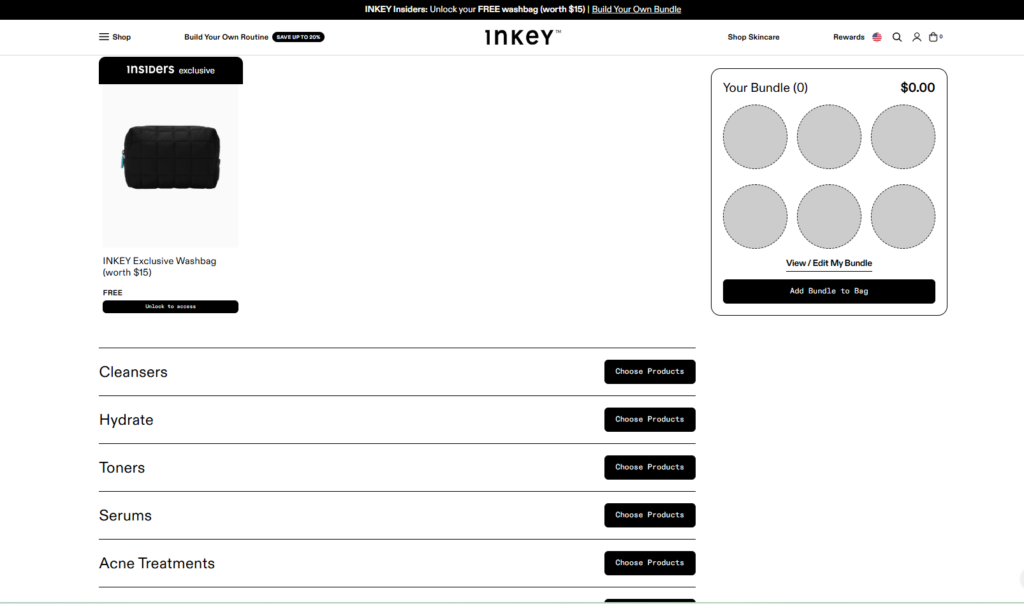
On Shopify: the native Bundles app does not support customer-choice Mix & Match, so this strategy needs a bundle app. Shopify bundle app like BOGOS handle build-your-own flows alongside fixed bundles and discounts from one dashboard.
Tip: Label each slot by its role (“Your Cleanser,” “Your Serum,” “Your Moisturizer”) so shoppers think in terms of completing a routine, and show a running total so the saving stays in view.
Watch out: Avoid open-ended builders for products that need expert guidance, such as specialized supplements or technical gear. There, customers need direction, not a blank selector, and a Fixed Bundle usually converts better.
Next step: choose products that swap easily and that customers already buy in multiples, then set a minimum quantity that feels reachable.
3. Volume and Multipack Bundles (buy more, save more)
A Volume or Tiered Discount rewards buying more units of the same product, either as a multipack (a 3-pack of one item) or as tiered price breaks (buy 2 save 10%, buy 3 save 15%).
Best for: increasing units per order, moving consumables, and lifting AOV on products customers replenish.
The mechanism is a per-unit price that drops as quantity rises, which pulls shoppers up one tier. Coffee, supplements, skincare basics, and other repeat-purchase items respond well because buying ahead is convenient rather than wasteful.
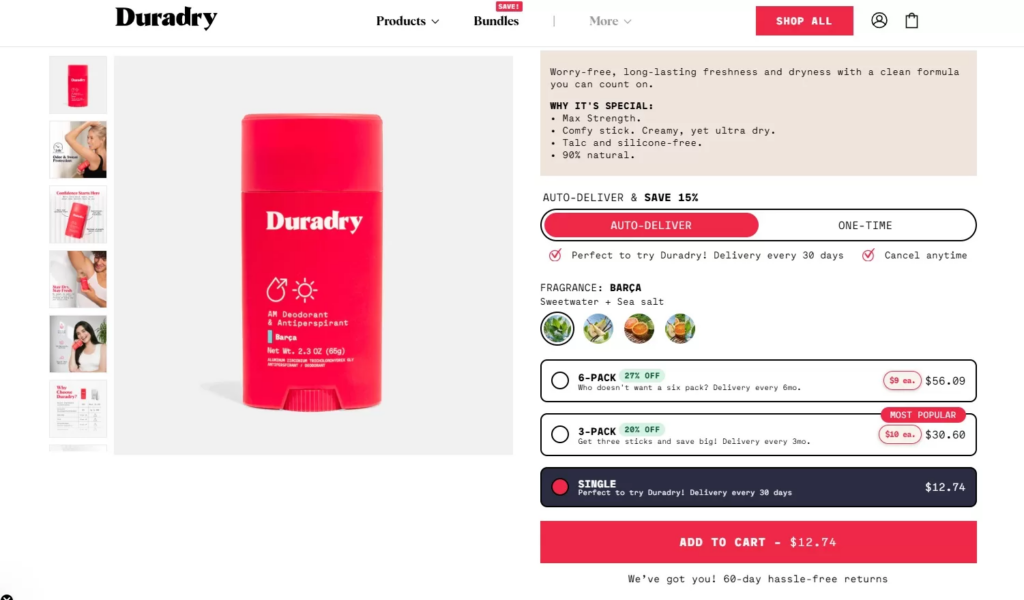
On Shopify: multipacks are supported by the native Bundles app. Percentage-based tiered breaks (buy 2, buy 3, buy 5) typically run through a volume discount app. Our guide to structuring volume discounts covers the tier math [#].
Tip: Make the middle tier your target offer and keep the jump to it small, then display the per-unit price at each tier so the saving is legible.
Watch out: Volume works for consumables and replenishables, not one-time or durable purchases. Set your top tier so the deepest discount still clears your margin floor.
Next step: identify your top three replenishable SKUs and add a two-step or three-step tier to each.
4. BOGO and BXGY (buy X, get Y)
A BOGO/BXGY offer gives the customer a second item free or discounted when they buy a qualifying item. The “get” item can be the same product or a complementary one.
Best for: clearing overstock, moving slow inventory, creating urgency, and introducing a product by attaching it to a bestseller.
The mechanism trades margin on one unit for volume and inventory movement on another. Because the incentive is a product rather than a percentage, it can feel more generous than the same discount in cash terms.
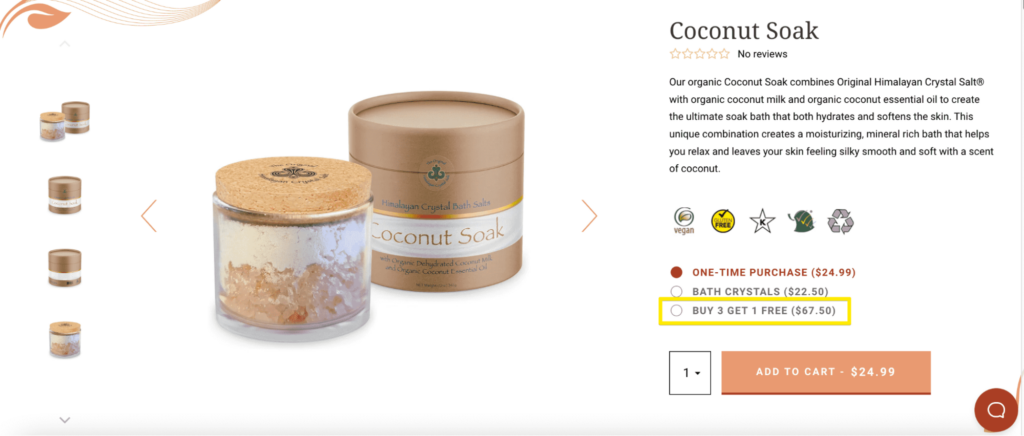
On Shopify: Shopify’s native discount system supports Buy X Get Y. A promotions app gives you more control over eligibility, placement, and which item is free or discounted, which matters for protecting margin.
Tip: Make the “get” item something you want to move or introduce, not your highest-cost product, and cap how many times the offer applies per order.
Watch out: BOGO can drain margin quickly if the free item is expensive. Model the blended margin across both items before you launch, not after.
Next step: pick a slow SKU as the “get” item and pair it with a fast-moving “buy” item to move both at once.
5. Complementary Cross-Sell Bundles (frequently bought together)
A cross-sell bundle surfaces genuinely complementary items at the point of decision, on the product page or in the cart, with or without a small incentive.
Best for: improving attach rate and product discovery, and raising AOV with little or no discount, which protects margin per order.
The mechanism is relevance at the right moment. A “goes well with” or “complete the look” prompt catches the customer while intent is high, so it can lift order value without cutting price at all.
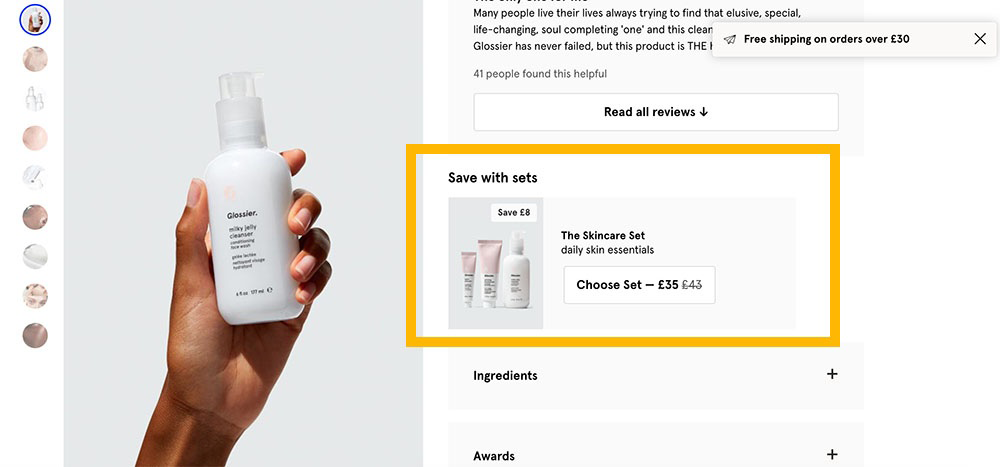
On Shopify: cross-sell placements on the product page or cart run through an upsell app, and you can attach a small bundle discount if you want to reward taking both.
Tip: Base pairings on real purchase data rather than guesses, and keep recommendations to one to three relevant items so you don’t create choice overload.
Watch out: Irrelevant recommendations read as clutter and get ignored. Relevance beats quantity every time, so a single well-matched suggestion outperforms a grid of loosely related ones.
Next step: pull your “frequently bought together” pairs from Shopify order data and add the strongest one to your top product page.
6. Gift and Seasonal Bundles
A gift or seasonal bundle curates a themed set around an occasion, presented for gifting and priced for clear, high perceived value.
Best for: capturing gifting demand, raising perceived value, driving Q4 and holiday AOV, and introducing new customers through giftable sets.
The mechanism is timing plus presentation. Gift buyers spend more freely and value convenience, so a ready-made, well-packaged set removes the work of choosing and justifies a higher order value.
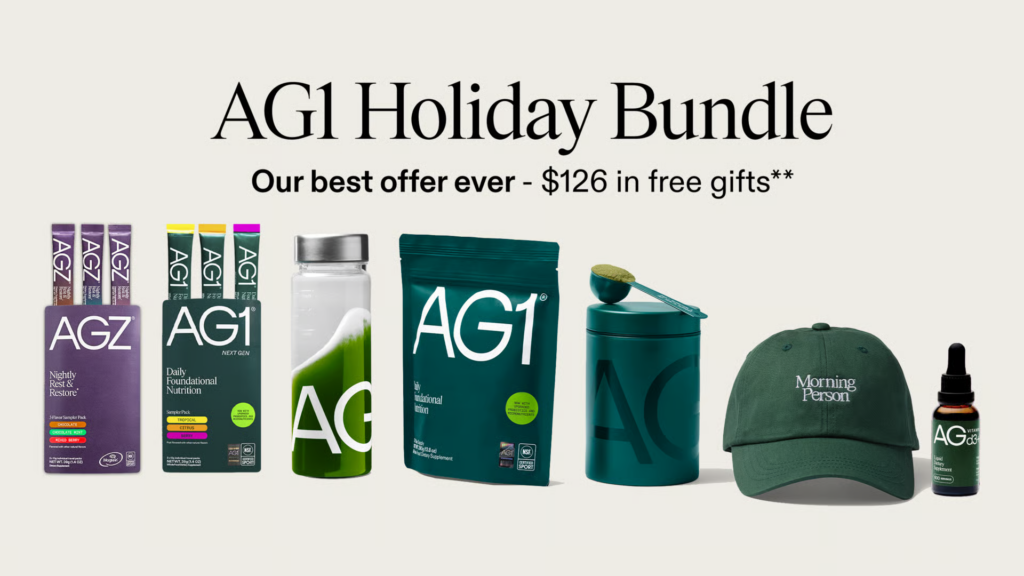
On Shopify: build it as a Fixed Bundle with the native app for a set lineup, or as a Mix & Match gift builder with an app if you want the buyer to choose within a theme. Group these into a dedicated seasonal collection so they’re easy to find and promote.
Tip: Refresh sets each season, and offer an optional premium packaging upgrade at checkout, since gift shoppers are already in a generous mindset.
Watch out: Gift bundles are time-boxed. Plan inventory for the spike, and retire the set after the occasion so your storefront doesn’t look stale in February.
Next step: map your next two gifting occasions and pre-build one set for each so you’re not scrambling the week before.
How to Actually Build These on Shopify
Shopify’s native tooling covers some of these strategies and not others, so the build method depends on the bundle type you chose above.
| Bundle type | Native Shopify option | When you need an app |
| Fixed Bundle | Free Shopify Bundles app, real-time inventory sync | Advanced pricing rules or tiered logic |
| Multipack | Free Shopify Bundles app | Percentage tiers (buy 2, buy 3, buy 5) |
| Mix & Match / build-your-own | Not supported natively | Always needs a bundle app |
| Volume / Tiered Discount | Basic quantity multipacks only | Percentage-based tier breaks |
| BOGO / BXGY | Native Buy X Get Y discount | Placement, eligibility, and margin controls |
| Cross-sell/gift builder | Fixed sets only | Customer-choice builders and upsell placement |
A few Shopify realities decide the rest of the build.
First, Shopify Scripts was sunset on June 30, 2026, so any tutorial that tells you to write a Script no longer applies. Use the native discount system or an app instead.
Second, native bundles cannot be sold with selling plans, which means subscriptions, pre-orders, and try-before-you-buy. If you want a bundle that also ships on a recurring cadence, you’ll need an app that supports both.
Third, inventory sync is the detail that breaks operations if you skip it. The native Bundles app deducts stock from each component in real time, and any app you choose should do the same to avoid overselling a bundle when one child SKU runs out.
For stores that run several of these strategies, one option is to manage them from a single app rather than stacking three or four. BOGOS Shopify bundles app covers Mix & Match, build-your-own, Fixed Bundles, BOGO/BXGY, Volume Discounts, and free gifts in one place, which keeps setup and reporting consolidated.
Next step: match your chosen strategy to the table above, confirm the inventory behavior, and build one bundle before scaling to the rest.
Common Bundling Mistakes to Avoid
Most underperforming bundles fail for a handful of predictable reasons. Check yours against these before you launch.
- Grouping unrelated products. A bundle works when the items clearly belong together. Pairing random clearance stock feels like a sales tactic, not a solution.
- Over-discounting. Deep, permanent bundle discounts train customers to wait and drag down margin. Use the smallest incentive that still converts.
- Hiding the bundle. A bundle no one sees can’t lift AOV. Link it from your menu, product pages, and cart, not just a buried collection.
- Ignoring inventory constraints. Bundles draw down multiple SKUs at once. Confirm real-time sync so a single out-of-stock component doesn’t oversell the set.
- Bundling around subscriptions natively. Native bundles can’t use selling plans, so a “subscribe and save the bundle” offer needs an app, not the free tool.
- Forcing a bundle where a cross-sell fits better. If items are complementary but not a set, a “frequently bought together” prompt often converts better than a formal bundle.
Next step: run this list against your current bundles and fix the one issue that’s costing you the most.
Conclusion
Bundling isn’t a single tactic, and the best strategy is the one that matches your goal. Fixed Bundles and Mix & Match raise AOV, Volume and BOGO move units and inventory, and cross-sell and gift bundles lift order value with less discounting.
The path is the same each time: start from the goal, pick the matching strategy, build it with the right Shopify tool, and protect your margin and inventory as you go.
Pick one goal this week, choose the strategy above that serves it, and ship a single bundle. One focused bundle you can measure beats five you launched on a hunch.