Adobe Commerce Cloud doesn’t follow a fixed pricing model.
You get custom pricing based on the GMV(Gross Merchandise Value), infrastructure needs, and overall business complexity.
In this guide, get a breakdown of the Adobe Commerce Cloud pricing for 2026 and factors that affect it to budget accordingly.
What Is Adobe Commerce Cloud?
Adobe Commerce Cloud is the cloud-hosted, fully managed version of Magento.
It includes powerful e-commerce features, secure hosting, automatic scaling, AI-driven merchandising, and built-in performance tools, all handled by Adobe, so you don’t need to manage servers or technical setup.
Many merchants are now shifting to Adobe’s SaaS-based model because it removes much of the manual technical work. This is the key differentiating factor compared to Magento Open Source.
While Magento Open Source is free but self-hosted, meaning you manage the hosting, security, and upgrades yourself, Adobe Commerce Cloud is a paid enterprise solution where Adobe handles the infrastructure for you and delivers advanced features right out of the box.
Best suited for growing and enterprise businesses that need reliable hosting, advanced B2B or B2C features, strong security, and the flexibility to customize almost anything, without worrying about server management.
Adobe Commerce Cloud Cost Overview in 2026
Since Adobe does not have a standard price list, the final cost is determined by your business’s annual revenue and operational complexity.
Here’s a cost overview based on industry estimates and benchmarks.
| Annual Revenue (GMV) | Est. Annual License Fee | Hosting & Security | Inclusions |
| <$1 Million | $40,000 | Included | Adobe Sensei AI, Managed SaaS/PaaS |
| $1M – $5 Million | $55,000 | Included | B2B Suite, Automated Backups |
| $5M – $10 Million | $80,000 | Included | Dedicated Support, DDoS/WAF |
| $10M – $25 Million | $120,000 | Included | Advanced Segmentation, Visual Merchandiser |
| $25 Million+ | $200,000+ | Included | Unlimited Store Views, Custom Scaling |
In addition to the recurring license, your Total Cost of Ownership (TCO) will include:
| Expense | Estimated Cost | Frequency |
| Implementation | $50,000 – $250,000+ | One-time |
| Third-Party Extensions | $0 – $10,000+ | Annual/One-time |
| Maintenance & Support | $100 – $250 / hour | Ongoing |
| Domain Name | $10 – $20 | Annual |
How Adobe Commerce Cloud Pricing Works?
Adobe Commerce Cloud uses a value-based, tiered pricing structure designed to scale alongside your business’s growth. Because the platform is built for high-volume enterprises, your final quote is determined by three primary factors:
Gross Merchandise Value (GMV)
This is the significant driver of your license fee. Adobe looks at the total sales, and as per your revenue, your pricing tier is adjusted to reflect the increased value and support the platform provides.
Business size and complexity
The cost is influenced by the scope of your operations. A global brand managing multiple storefronts, international currencies, and complex B2B workflows (like custom price books and quote negotiations) will require a different pricing tier than a mid-market retailer operating in a single region.
Infrastructure requirements
Unlike basic platforms, Adobe Commerce Cloud includes high-performance managed hosting on AWS or Azure. Pricing reflects these requirements, including the server capacity needed to handle your specific traffic patterns, the number of transactions per hour, and the storage required for your product catalog.
This customized approach ensures that your investment matches the actual resources your store consumes.
Adobe Commerce Cloud Pricing Tiers (Estimated)
Adobe Commerce Cloud uses the Gross Merchandise Value (GMV) model. This means your annual license fee is tiered based on the total revenue your store processes.
Below are the estimated price ranges for the Cloud (PaaS) version, which include managed hosting and enterprise features.
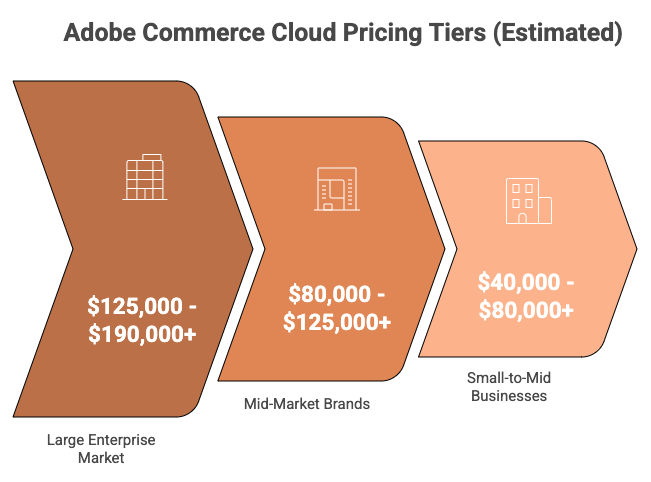
Small-to-Mid Businesses
Estimated range: $40,000 – $80,000+ per year
Often use the starter Cloud packages. These tiers are ideal for brands moving off basic platforms who need the advanced SEO and multi-store capabilities of Adobe but have relatively predictable traffic.
Mid-Market Brands
Estimated range: $80,000 – $125,000+ per year
This is the sweet spot for Adobe Commerce. These merchants typically utilize the full B2B suite and integrated AI tools (Adobe Sensei). Pricing increases here to account for higher server resource consumption and more complex data processing.
Large Enterprise Market
Estimated range: $125,000 – $190,000+ per year
These merchants require high-availability infrastructure with dedicated support. At this level, the price reflects the cost of managing massive product catalogs (100k+ SKUs), complex ERP integrations, and global auto-scaling to handle peak events like Black Friday.
What’s Included in Adobe Commerce Cloud Pricing
When you pay for Adobe Commerce Cloud, you are investing in a fully managed ecosystem. The pricing bundles the application, the hosting, and the security into a single annual fee.
Here is the breakdown of what is included in that cost:
Licensing and Platform Features
Adobe Commerce License – You get full access to the core commerce engine, which supports both B2C and B2B models from a single admin panel.
Advanced B2B Suite – This includes advanced features like company accounts, custom shared catalogs, and automated quote negotiation workflows that aren’t available in the free version.
AI-Powered Merchandising – Powered by Adobe Sensei, this includes smart product recommendations, live search with visual results, and automated category sorting based on customer behavior.
Cloud Infrastructure and Hosting
Managed Cloud Hosting – Your store is hosted on enterprise-grade infrastructure (AWS or Azure). Adobe manages the server configuration, so you don’t need a dedicated DevOps team.
Auto-scaling – The platform automatically adds server capacity during traffic peaks and scales back down afterward to maintain performance without crashing.
CDN & Performance Optimization – Includes a built-in Content Delivery Network (CDN) and Fastly integration, which speeds up your site globally by storing images and content closer to your customers.
Security, Compliance & Support
PCI Compliance – The infrastructure is Level 1 PCI DSS certified, which significantly simplifies the legal work your business needs to do to handle credit card data securely.
Automated Security Patches – Adobe proactively applies critical security fixes to the core platform and cloud environment, keeping your store protected from new threats.
24×7 Adobe Support – You get a dedicated support line for technical issues, ensuring that if something goes wrong with the infrastructure or core code, you have expert help available around the clock.
Hidden Costs of Adobe Commerce Cloud You Should Know
While the Adobe license gets you in the door, actually building and running a high-performing store requires several extra investments. These hidden costs are often where most of your budget ends up.
Development & Customization Costs
Because Adobe Commerce is built for total flexibility, you rarely use it in its default form.
A basic theme setup can cost $5,000 – $20,000, but a fully custom UI/UX designed for high conversion often starts at $50,000+.
Many brands are opting for Hyvä Themes to boost speed, which can reduce development time but still requires expert styling.
If your business has a unique process, like a complex loyalty program or a specific B2B ordering flow, you’ll need custom-coded modules. Development rates for certified Adobe partners range per hour vary from country to country, with complex features often taking 100+ hours to build.
Many brands choose to hire offshore Magento developers to access the same level of certified expertise at more competitive rates (typically $30–$60/hour).
Extension & Third-Party Integrations
Every store needs to connect smoothly with your other business tools.
While there are thousands of ready-made extensions, enterprise-grade modules for SEO, advanced shipping, or tax calculation can cost anywhere from $29 to $500.
Connecting your store to systems like NetSuite, SAP, or Salesforce is a major undertaking. These integrations ensure your inventory and customer data stay synced in real-time.
Ongoing Maintenance & Optimization
Launching the site is just the beginning. To keep it competitive, you need a recurring budget for upkeep.
As your product catalog grows, you’ll need regular audits to keep load times low. Brands typically spend $2,000 – $10,000 per year on specialized performance optimization.
Adobe releases monthly security patches and an annual major feature update. Budget a portion of your initial build cost each year for an agency to test and apply updates, ensuring your customizations don’t break when the platform upgrades.
Adobe Commerce Cloud Pricing vs Magento Open Source
While both platforms share the same core code, they are designed for very different business needs.
The Open Source version is a DIY approach that is free to download, while Adobe Commerce Cloud is a premium, all-inclusive managed service for high-growth enterprises.
| Feature | Magento Open Source | Adobe Commerce Cloud |
| Annual License Fee | $0 (Free) | Paid enterprise license |
| Hosting & Servers | Self-managed | Included, managed AWS/Azure infrastructure |
| B2B Capabilities | Requires 3rd-party extensions | Natively Integrated (Quotes, Catalogs) |
| AI Features | None (requires external tools) | Adobe Sensei AI (Smart search/suggestions) |
| Technical Support | Community forums / Self-help | 24×7 Dedicated Adobe Support |
| Security & PCI | Merchant responsibility | PCI Level 1 Certified (Built-in) |
Is Adobe Commerce Cloud Worth the Price in 2026?
Adobe Commerce Cloud is recognized as a high-performance platform, but it carries a significant price tag.
Here are the major pros and cons to consider:
The Pros
- Full access to the source code, allowing you to build unique checkout flows and complex business rules
- Includes Adobe Sensei, which powers smart search, personalized product recommendations, and automated merchandising to boost conversion rates
- Hosting included on AWS or Azure with auto-scaling capabilities, ensuring your site stays online during massive traffic spikes like BFCM
- B2B tools such as custom shared catalogs, application lists, and native quote negotiation features
- Includes Level 1 PCI compliance, a global CDN, and a Web Application Firewall (WAF) to protect against DDoS attacks
- Integrates with other Adobe tools like Analytics, Target, and Real-Time CDP for a unified data strategy.
The Cons
- Expensive specialized developers and agency retainers to maintain the platform
- Often requires professional training for your marketing and IT teams due to the complex admin panel and technical architecture
- A fully customized launch typically takes 4 to 9 months, compared to weeks on simpler platforms
- Need a technical development team or an external agency for updates and troubleshooting
- Most stores require substantial configuration to match business needs
How to Reduce Adobe Commerce Cloud Costs
Even though Adobe Commerce Cloud is a premium platform, you can still reduce your Total Cost of Ownership by making smart decisions.
Choose the Right Development Partner
The biggest drain on an Adobe Commerce budget is its inefficient development.
Picking an uncertified agency may take longer to finish tasks and create heavy code that slows down your site. Working with a certified Adobe Solution Partner helps ensure best practices are followed and reduces long-term technical debt.
Look for a partner that offers a clear post-launch strategy, with structured maintenance retainers instead of costly emergency fixes.
Many brands now use a hybrid approach, working with a local agency for strategy and partnering with offshore certified developers for backend tasks. This gives them strong technical quality while keeping costs lower.
Plan Features Before You Build
Scope creep is the biggest reason budgets explode. With proper planning, brands can avoid this and save a lot of money.
Adobe Commerce comes with many built-in features such as B2B quoting, Page Builder, and Gift Cards. Before investing in custom development or buying extra extensions, check whether the platform’s native tools can solve your problem with a simple setup.
Instead of launching with complex integrations, start with a simple MVP. Get the core store live first, then add advanced features, like AI personalization or loyalty systems, after the site starts making money.
Project costs increase when developers have to fix messy product or customer data during migration. Cleaning your spreadsheets and organizing your data structure before development begins can save a lot of time and money.
FAQs
How much does Adobe Commerce Cloud cost in 2026?
In 2026, Adobe Commerce Cloud typically costs $40,000 – $200,000+ per year for licenses, and total yearly expenses can reach $122,000 -$450,000+, depending on GMV.
Does Adobe Commerce Cloud include hosting?
Yes, Adobe Commerce Cloud comes with managed hosting. It works as a PaaS and runs on Amazon Web Services (AWS) and Microsoft Azure.
Can small businesses afford Adobe Commerce Cloud?
Small businesses can use Adobe Commerce, but for most early-stage or low-budget brands, it’s usually too costly and complex to be practical.
Rounding up, Adobe Commerce Cloud Pricing [2026] reflects the platform’s enterprise-grade capabilities, combining powerful features with fully managed cloud infrastructure. For brands focused on scalability, performance, and long-term growth, it remains one of the most robust and future-ready eCommerce solutions